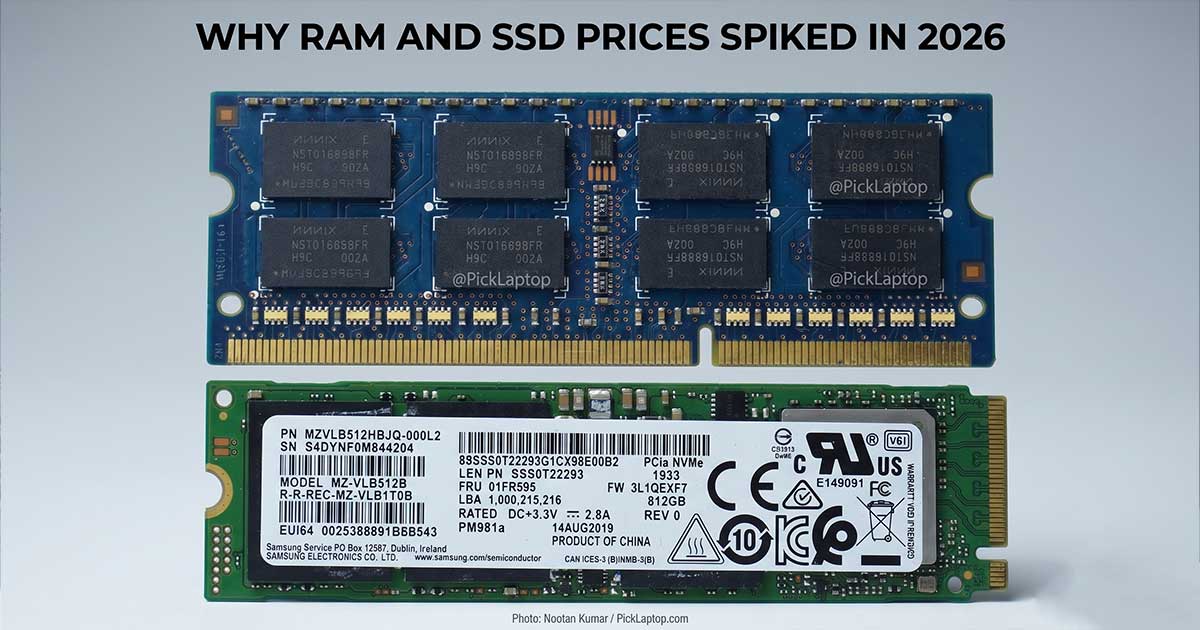
If a laptop you were eyeing six months ago costs noticeably more today with the same specs, you’re not imagining it. RAM and SSD storage — two of the most basic components in every laptop — have gone through one of the sharpest price increases the memory industry has seen in years, and the cause has nothing to do with laptops at all.
What’s Inside
The Numbers: How Much Prices Actually Jumped
According to TrendForce, conventional DRAM contract prices surged 90-95% quarter-over-quarter in Q1 2026 alone, while NAND flash (the chips inside SSDs) rose 55-60% in the same period — with NAND projected to climb another 70-75% in Q2. HP’s own financial disclosures, reported by Tom’s Hardware, stated that memory costs doubled in a single quarter and now account for roughly 35% of the total bill of materials in a PC — a component that used to be a minor line item is now over a third of what it costs to build the machine.
Why This Is Happening: AI Is Eating the RAM Supply
This isn’t a laptop-industry problem — it’s a side effect of the AI data center buildout. High Bandwidth Memory (HBM), the specialized memory used in AI accelerator chips, now consumes roughly 23% of total global DRAM wafer output in 2026, up from about 19% the year before, and HBM production uses a 3-to-1 wafer ratio against standard DDR5 — meaning every wafer diverted to HBM removes three times the equivalent consumer memory capacity from the market. Manufacturers have a strong financial incentive to make that trade: HBM reportedly earns 3-5x the revenue per wafer compared to conventional DDR5, so Samsung, SK Hynix, and Micron have all been converting production capacity toward it.
NAND flash for SSDs is caught in a related but separate squeeze — enterprise SSDs are increasingly replacing hard drives in AI data centers for faster random I/O, which absorbs NAND production that would otherwise reach consumer drives.
Is There Any Relief Coming?
Not soon, and not fully. Samsung and SK Hynix have both warned the shortage could persist through 2027, with some analysts projecting elevated pricing into 2030. There are early, modest signs of cooling — Tom’s Hardware reports the pace has started moderating by Q3 2026 as consumers hit real affordability limits and PC manufacturers work through SSD inventory they’d already stocked — but that’s a slowdown in the rate of increase, not a return to 2025 pricing. Because the shortage is structural (driven by AI infrastructure investment, not a temporary demand spike), a real correction depends on new fab capacity coming online, which takes years, not months.
What This Means for Laptop Buyers Right Now
If you’re shopping for a laptop and RAM or storage upgrades are optional add-ons at checkout, expect those upgrade prices specifically to have jumped more than the base configuration — component costs hit upgrade tiers disproportionately since manufacturers pass the increase through directly. If you were already planning to buy soon, there’s a reasonable case for not waiting: given the current trajectory, prices are more likely to be higher in six months than lower.
If budget is the real constraint, it’s worth distinguishing what you actually need more of. For most everyday use, 16GB of RAM remains a comfortable floor regardless of price pressure — don’t feel pushed into a 32GB configuration you don’t need just because prices are already elevated either way. For storage specifically, buying only the capacity you’ll genuinely use, and offloading large files to cloud storage or an external drive instead of paying premium prices for a bigger built-in SSD, is a more sensible way to manage the current market than it would have been a year ago.
If you’re deciding what to buy given current pricing, our buying guides are updated with current-generation picks and configurations across budgets.

If I am dead and gone, Will the prices return to normal?
I think so.
This was planned. Totally planned.
Hang in there—the silicon cycle usually swings back before reincarnation kicks in.
Great breakdown! Didn’t know AI data centers were the real reason RAM and SSD prices went up so much. I was comparing prices on orangehardwares last week and couldn’t figure out why they jumped so fast, this makes total sense now. Thanks for explaining it so clearly!
Glad the post cleared things up! The enterprise AI pull on wafer capacity is wild right now, and consumer hardware always takes the hit first. Thanks for stopping by and sharing your experience!