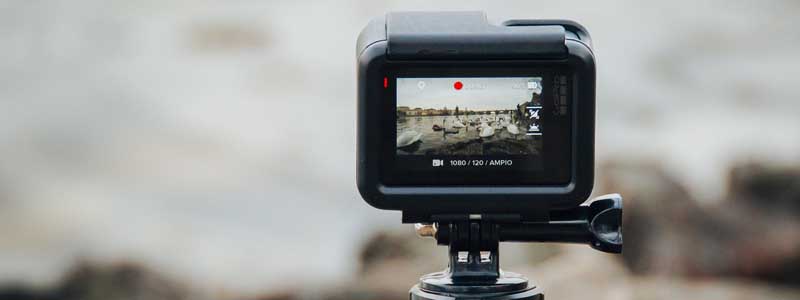
Since the HERO11, every GoPro resolution above 1080p is written as 10-bit HEVC, and Have Camera Will Travel documents that the menu option to switch back to H.264 was removed on the HERO11, HERO12 and HERO13 — H.264 survives only at 1080p, 60fps or below, in 8-bit. Whether a laptop plays that file back in real time comes down to a fixed-function decode block on the chip, which is a different piece of silicon from the shader cores a GPU spec sheet counts.
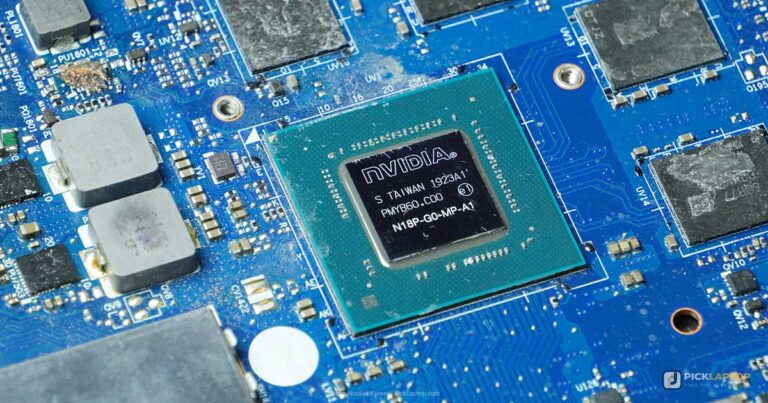
That block sits in Intel’s Quick Sync engine, in AMD’s integrated Radeon graphics, in Apple’s media engine, and in NVIDIA’s discrete GPUs — and Puget Systems’ breakdown of Premiere Pro’s decoding support shows coverage varies by bit depth and chroma subsampling rather than by how fast the chip is. So a discrete GPU is not what buys you a timeline you can scrub. It buys effects, color grading and export speed. Those are worth paying for; they are a separate question from playback, and the seven laptops below are ordered by how much of that second question applies to you.
Editor’s Pick


Last update on 2026-10-19 / Affiliate links / Images from Amazon Product Advertising API
Apple’s media engine decodes HEVC in fixed-function silicon with no discrete GPU involved, in a fanless chassis light enough to cut footage from a trip on the trip.
- Apple M5 10-core CPU
- 16GB unified memory
- 512GB SSD
- 13.6-inch Liquid Retina display
What’s Inside
- 1 – GoPro Video Editing Laptop Buyer's Guide
- 2 – GoPro Video Editing Laptop Comparison Table
- 3 – Best Laptops for GoPro Video Editing in 2026 — Reviews
- 3.1 – 1. Acer Aspire Go 15 AI (No Discrete GPU Needed)
- 3.2 – 2. HP Victus 15 (Entry-Level GPU Pick)
- 3.3 – 3. Gigabyte Aero X16 (Best for Heavier Multi-Cam Edits)
- 3.4 – 4. Lenovo Legion Pro 7i Gen 10 (Best for Export-Heavy Timelines)
- 3.5 – 5. Apple MacBook Air 13-inch M5 (Best Portable Mac)
- 3.6 – 6. Apple MacBook Pro 14-inch M5 Pro or Max (Best Mac for Multi-Cam Work)
- 3.7 – 7. LG gram 15 (Lightest and Durability-Tested)
- 4 – Recommended Accessories
- 5 – Which GoPro Video Editing Laptop Should You Buy?
- 6 – GoPro Video Editing Laptop FAQ
- 7 – Final Thoughts on GoPro Video Editing Laptops
GoPro Video Editing Laptop Buyer’s Guide
Start with the software, because one option went away. GoPro pulled Quik Desktop for Mac from the App Store on 31 December and said a Windows version would not be released, redirecting editing to its mobile apps. Desktop editing now means DaVinci Resolve, Adobe Premiere Pro or Final Cut Pro. GoPro still ships GoPro Player + HyperSmooth Pro for macOS and Windows, but that is a Premium+ subscription tool for 360 and HyperSmooth work, not a general editor.
Hardware Decode for GoPro HEVC
On a HERO11 or newer, 5.3K, 4K and 2.7K are HEVC-only modes with no H.264 fallback. Decoding that stream on general-purpose CPU cores is the slow path; a fixed-function decoder does the same work in dedicated silicon, drawing far less power for it. Every chip on this list carries one. Coverage is what varies, and not in the direction a price list would suggest: Puget Systems records that NVIDIA’s RTX 50-series only gained 10-bit 4:2:0 HEVC decoding in Premiere Pro 25.3, a variant Quick Sync had handled for years.
Processor
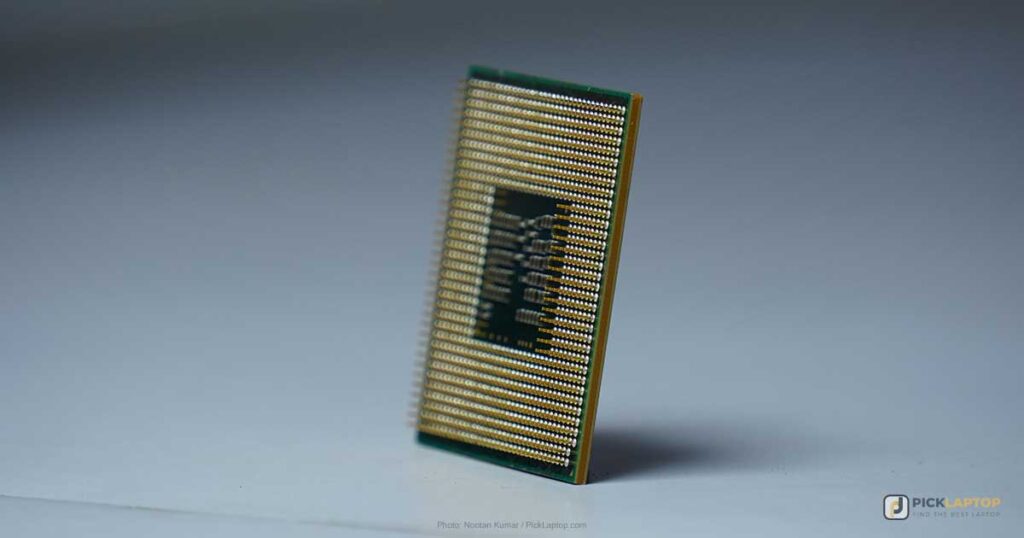
A Core 5/i5 or Ryzen 5 of the current crop runs a single-angle GoPro timeline with cuts, transitions and basic correction. Core count starts to matter on the parts of the job that are not decoding: effects rendering, noise reduction, and the encode at the end of an export. Multi-cam is where both matter at once, since every additional angle is another HEVC stream to decode before anything else happens to it.
Memory (RAM)
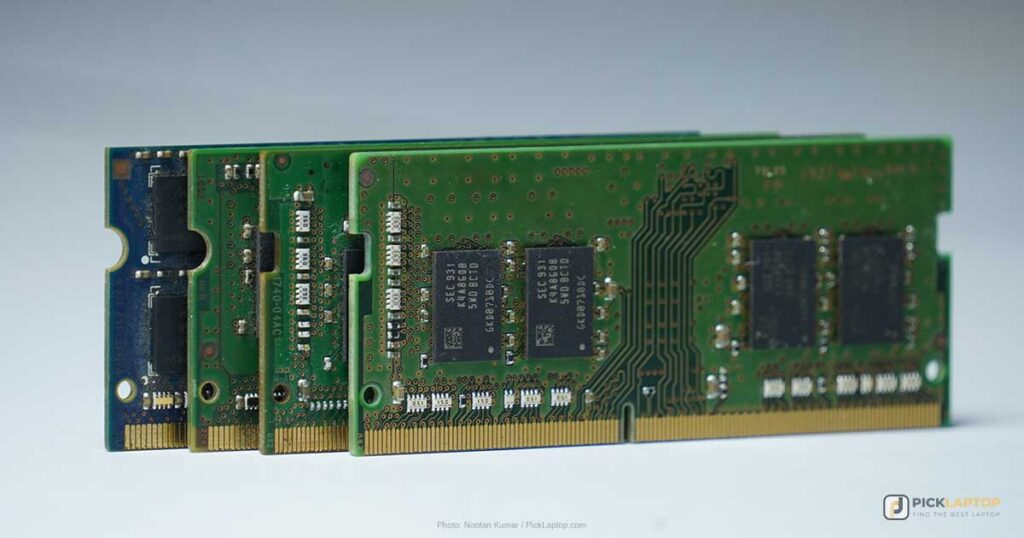
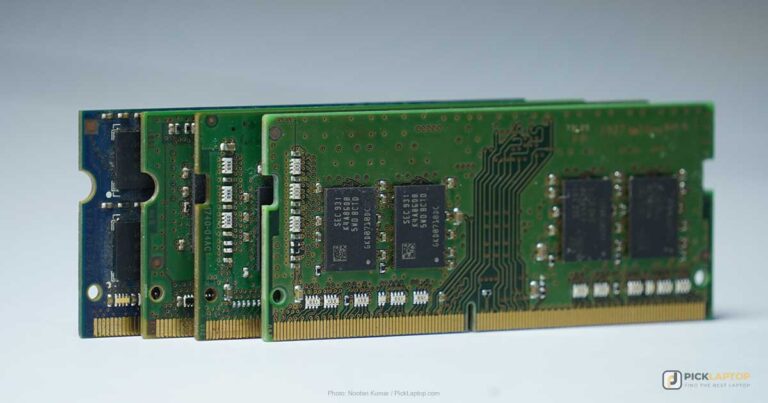
As a practical rule of thumb, 16GB runs a single-camera project with a handful of clips and moderate effects. 32GB is the figure to reach for once you are syncing two or three angles or working a long-form 5.3K project, because each open stream holds its own decoded frames and cache in memory. Count the angles and the effects you run at once rather than the length of the finished video.
Storage
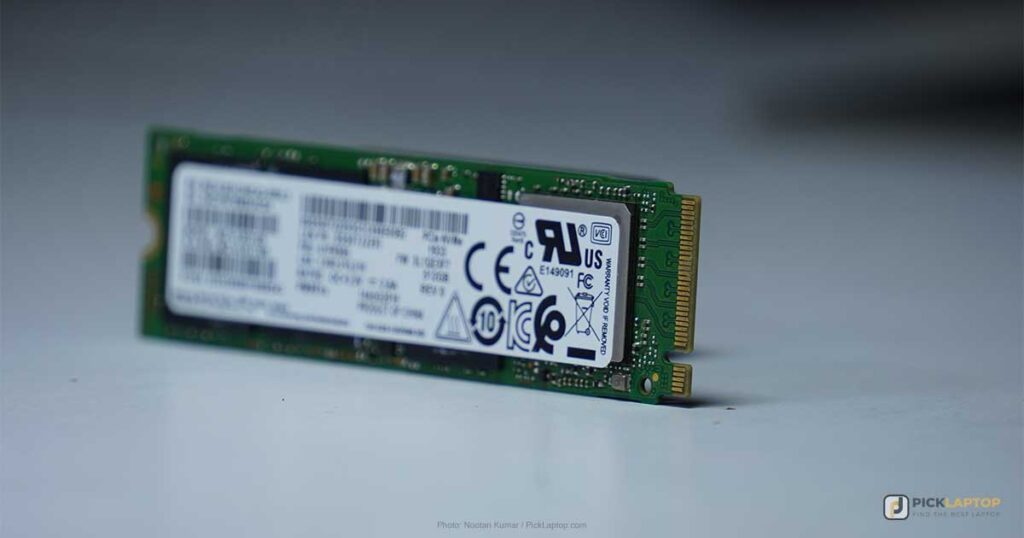
GoPro footage is bulky — an hour of 4K60 HEVC runs well past 20GB. 512GB works if you offload cards after each shoot; 1TB is the starting point if a project library lives on the internal drive. Every pick below ships an NVMe SSD, and a portable SSD for archives (see the accessories section) is a separate line in the budget rather than a reason to buy more internal storage than you need.
Display
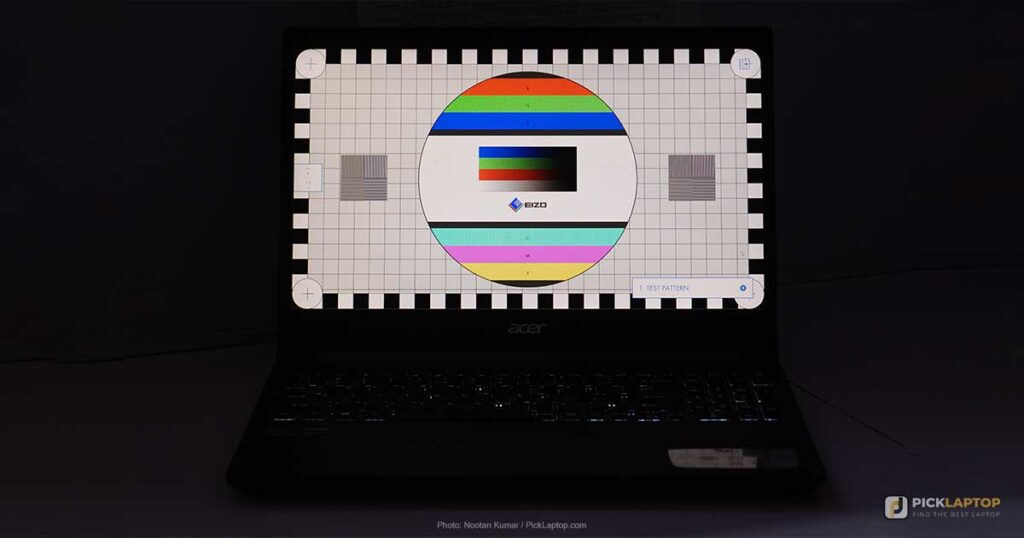
Panel type tells you nothing about color coverage, and this is the specification budget laptops quietly skip. IPS describes viewing angles, not gamut, and two IPS panels in this guide sit a long way apart on measured coverage. Manufacturers rarely print the figure on a listing and often ship several panels under one model name, so if you grade color rather than only cut clips, get the sRGB or DCI-P3 number for the exact SKU before you buy — or plan on an external display. 15.6 inches or larger keeps a multi-track timeline readable; 4K on the panel is a convenience for judging fine detail, not a requirement for editing 4K footage.
Connectivity
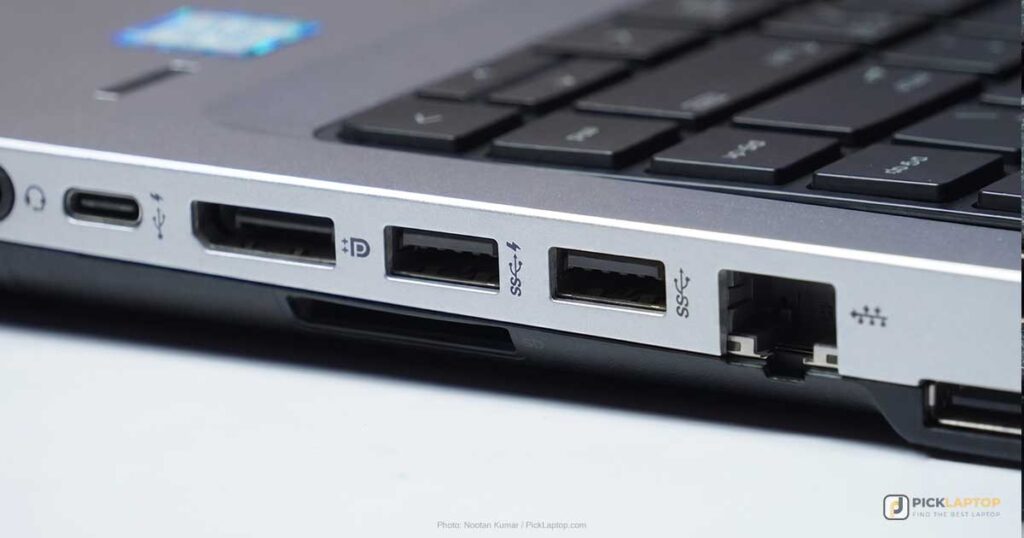
An SD or microSD reader, built in or on a small adapter, plus USB-C for the external drive the archive ends up on. Thunderbolt matters here only if you edit off an external SSD rather than copying to the internal drive first.
GoPro Video Editing Laptop Comparison Table




Last update on 2026-10-19 / Affiliate links / Images from Amazon Product Advertising API
Best Laptops for GoPro Video Editing in 2026 — Reviews
Seven machines, from one with no discrete GPU at all to a workstation-class gaming laptop, plus two Macs that put the decoder in the SoC.
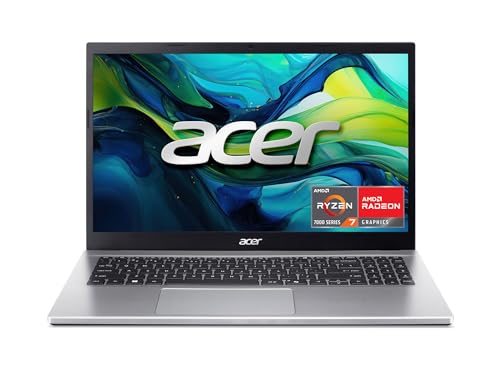
1. Acer Aspire Go 15 AI (No Discrete GPU Needed)
No Discrete GPU Needed
Last update on 2026-10-19 / Affiliate links / Images from Amazon Product Advertising API
- ProcessorAMD Ryzen 7 7730U (8-core)
- GPUAMD Radeon integrated graphics (HEVC decode block)
- RAM16GB DDR4
- Storage512GB PCIe NVMe SSD
- Display15.6-inch Full HD IPS
- ModelAG15-42P
Eight Zen 3 cores and Radeon integrated graphics with a video decode block, for cuts, correction and export in DaVinci Resolve or Premiere without a GPU line item. Encoding is where the absence shows, since that runs on shader hardware this machine does not have, and the GPU picks below finish an export several times sooner.
Acer sells several very different laptops under the Aspire Go 15 name, and the published reviews cover the other ones: PCWorld tested an Intel Core i3-N355 model, Notebookcheck a Core i5-1334U model. Nobody has measured the Ryzen 7 7730U configuration, so its panel brightness, color coverage, speaker quality and battery runtime are all manufacturer specification and nothing else. Both tested variants landed near 65% sRGB, which is at least a hint of what the panel here is likely to be.
Buy this one for cutting and organizing. If your edits carry stacked effects or you export against a deadline, the money is better spent on one of the GPU picks below.
Pros
- Hardware HEVC decode without paying for a discrete GPU
- 16GB RAM at the entry tier
- 512GB NVMe SSD as standard
Cons
- No independent lab has tested this Ryzen 7 7730U configuration — display, battery and audio figures are unverified
- Encode and effects rendering are far slower than the GPU picks
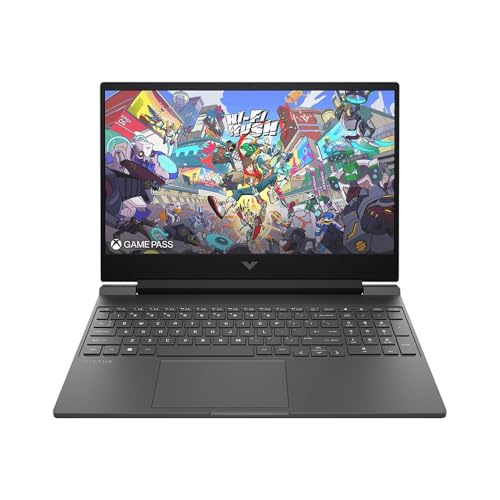
2. HP Victus 15 (Entry-Level GPU Pick)
Entry-Level GPU Pick
Last update on 2026-10-19 / Affiliate links / Images from Amazon Product Advertising API
- ProcessorAMD Ryzen AI 5 340 (Intel Core 5 210H also offered)
- GPUNVIDIA GeForce RTX 5050 (8GB)
- RAM16GB DDR5-5600
- Storage1TB NVMe SSD
- Display15.6-inch Full HD
- Battery70Wh
The RTX 5050 changes the second half of the job: GPU-accelerated effects, Lumetri grades and the encode at export all run on hardware the Aspire Go does not have. 1TB as standard keeps a project library on the internal drive, and 16GB carries two synced angles.
Notebookcheck measured 64.3% sRGB at 324 nits on the Full HD panel of the Victus 15 it tested, and rated the speakers average. That unit paired the same RTX 5050 with an Intel Core i5-13420H rather than the Ryzen chip listed here, so its CPU numbers do not transfer — but the panel figure is the one HP leaves off the listing, and it is enough for cutting and short of a grading pass. Headphones for any audio-critical review, and ask a seller which panel a given SKU carries.
Pros
- 1TB SSD as standard
- RTX 5050 takes GPU-accelerated effects and Lumetri grades off the CPU
- 16GB DDR5 at the entry GPU tier
Cons
- Notebookcheck measured 64.3% sRGB on the panel in its test unit
- Heavier than the ultraportables here
- Entry GPU tier — not built for stacked effects timelines
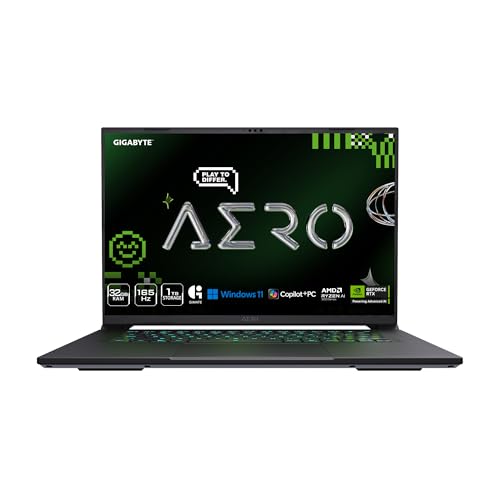
3. Gigabyte Aero X16 (Best for Heavier Multi-Cam Edits)
Best for Heavier Edits
Last update on 2026-10-15 / Affiliate links / Images from Amazon Product Advertising API
- ProcessorAMD Ryzen AI 9 HX 370 (12-core); Ryzen AI 7 350 also offered
- GPUNVIDIA RTX 5070 (8GB GDDR7)
- RAM32GB DDR5
- Storage1TB SSD
- Display16-inch IPS
- Thickness0.65 inches
A helmet cam and a chest mount synced on one timeline means two HEVC streams decoding before a single effect is applied, which is what the 32GB here is for. The RTX 5070 takes the grade and the export. At 0.65 inches it packs into the same bag as the camera bodies — rare at this GPU tier.
Tom’s Hardware measured 78.5% DCI-P3 and 369 nits on the Aero X16 it reviewed — a Ryzen AI 7 350 unit, though the panel carries across the configurations — and counted the gamut shortfall against the laptop. For cutting and general correction that is enough. For a grade you intend to hold up it is a preview rather than a reference, and an external display is the fix. Tom’s also found the keyboard comfortable, uncommon in a chassis this thin.
Pros
- 32GB DDR5 for multi-angle timelines
- 0.65 inches thick with an RTX 5070 inside
- Tom’s Hardware found the keyboard comfortable
Cons
- 78.5% DCI-P3 and 369 nits measured by Tom’s Hardware — short of a grading panel
- Tom’s tested the Ryzen AI 7 350 variant, so no independent CPU figures exist for the HX 370
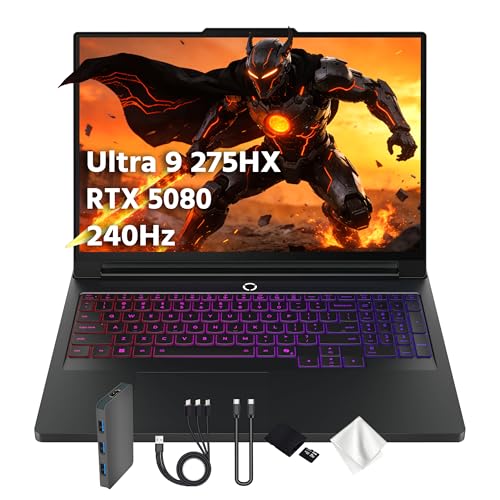
4. Lenovo Legion Pro 7i Gen 10 (Best for Export-Heavy Timelines)
Best for Export-Heavy Timelines
Last update on 2026-10-19 / Affiliate links / Images from Amazon Product Advertising API
- ProcessorIntel Core Ultra 9 275HX
- GPUNVIDIA RTX 5080 (16GB GDDR7)
- RAM32GB DDR5-6400
- Storage1TB PCIe SSD
- Display16-inch OLED, 2560 x 1600, 240Hz
- Battery4h 37m measured (Tom’s Hardware)
The highest GPU tier on this list, and the only pick here with a measured grading-grade panel. Tom’s Hardware recorded 465 nits and 138.9% of DCI-P3 on the OLED, ran a Handbrake transcode in 2 minutes 21 seconds, described the fan noise as unobtrusive enough to hear in-game audio at 30% volume, and typed 116 words per minute on a keyboard it called crisp rather than mushy.
The same review clocked 4 hours 37 minutes on its rundown test, last in its comparison group, so this one edits at a desk with the charger attached. If your GoPro work is a weekly cut rather than a queue of deadline exports, most of what you are paying for here sits idle.
Pros
- RTX 5080, the highest GPU tier in this guide
- 465 nits and 138.9% DCI-P3 measured — the one panel here you can grade on
- Tom’s Hardware found the fans quiet and the keyboard crisp
Cons
- 4h 37m measured battery life — a desk machine
- More GPU than a GoPro timeline alone calls for
- Heaviest chassis in this guide
5. Apple MacBook Air 13-inch M5 (Best Portable Mac)
Best Portable Mac
Last update on 2026-10-19 / Affiliate links / Images from Amazon Product Advertising API
- ProcessorApple M5 (10-core CPU)
- GPUApple M5 integrated graphics with media engine
- RAM16GB unified
- Storage512GB SSD
- Display13.6-inch Liquid Retina
- BatteryUp to 18 hours rated by Apple; 15h 28m measured by Tom’s Hardware
The M5’s media engine is fixed-function HEVC hardware sitting on the same die as the CPU, so Final Cut Pro and DaVinci Resolve get the decoder without a fan, a GPU or a power brick in the equation. Tom’s Hardware measured 15 hours 28 minutes against Apple’s 18-hour rating — a day of reviewing and rough-cutting the day’s cards away from an outlet either way.
Fanless has a measurable cost once the load stops being bursty. Tom’s Hardware watched the chip open a Cinebench 2026 stress loop at 3,415 and settle in the low 2,300s. Scrubbing, trimming and short exports rarely run long enough to get there. A batch export of a weekend’s footage does, repeatedly. The 16GB is soldered, so the configuration you order is the one you keep.
Pros
- Hardware HEVC decode on the SoC, no discrete GPU and no fan
- 15h 28m measured battery life, silent fanless chassis
- Light enough to edit on location
Cons
- Measurably throttles under sustained load — batch exports are its weak spot
- 16GB unified memory soldered, not upgradeable
- Two Thunderbolt ports and no SD reader; a hub or adapter is part of the purchase
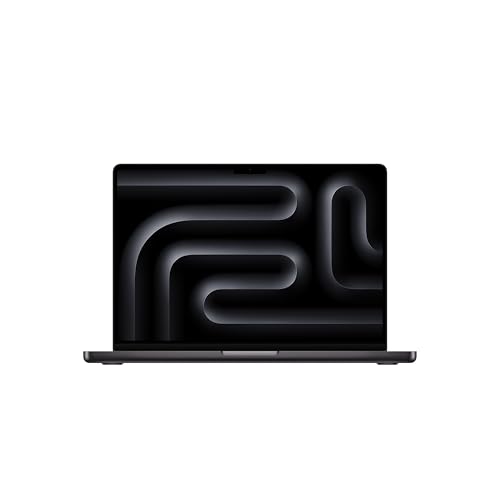
6. Apple MacBook Pro 14-inch M5 Pro or Max (Best Mac for Multi-Cam Work)
Best Mac for Multi-Cam Work
Last update on 2026-10-19 / Affiliate links / Images from Amazon Product Advertising API
- ProcessorApple M5 Pro (15-core) or M5 Max
- GPUIntegrated, up to 40-core on M5 Max, with media engine
- RAM24-128GB unified
- Storage1TB SSD (M5 Pro) / 2TB SSD (M5 Max)
- Display14.2-inch Mini-LED, 3024 x 1964, 120Hz
- BatteryUp to 22 hours video streaming rated by Apple (M5 Pro)
Two fans and a bigger media engine, which is what separates this from the Air: the throttling curve that limits a batch export on the fanless chassis does not apply the same way here. Unified memory goes to 128GB, and the Mini-LED panel is the display half of the multi-cam argument.
Notebookcheck’s review of a 40-core M5 Max with 128GB found inconsistent CPU results and throttling in the 14-inch chassis, and did not find it much faster than the M4 Max it replaced. The M5 Pro does not show that pattern. So paying up to Max in the smaller body is not automatically buying speed — check whether a listing that says only “M5” specifies Pro or Max before you order.
Against the Air, this is heavier and considerably more expensive. That trade only pays if the angles, the grade or the export queue have outgrown what the Air does between throttling points.
Pros
- Active cooling, so long exports are not the weak spot they are on the Air
- Unified memory to 128GB for many simultaneous streams
- Mini-LED panel at 3024 x 1964
Cons
- Notebookcheck found the 14-inch M5 Max throttling and inconsistent under sustained load
- Highest-priced pick here at the upper configurations
- More machine than a single-angle workflow uses
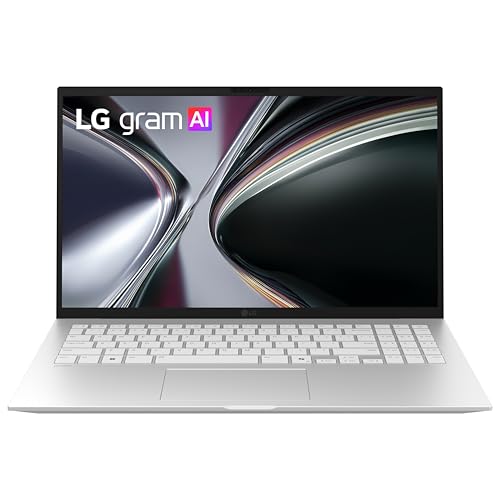
7. LG gram 15 (Lightest and Durability-Tested)
Lightest and Durability-Tested
Last update on 2026-10-19 / Affiliate links / Images from Amazon Product Advertising API
- ProcessorAMD Ryzen AI 7 350
- GPUAMD Radeon integrated graphics (HEVC decode block)
- RAM16GB
- Storage512GB or 1TB SSD by configuration
- Display15.6-inch Full HD anti-glare IPS touchscreen
- Battery72Wh; up to 22 hours video playback rated by LG
GoPro owners are disproportionately surfing, riding and hiking, which makes weight and durability decision-critical here in a way they are not for a desk editor. LG lists the 15Z80T at 2.84 lb with a 72Wh battery, and says it passed 7 MIL-STD-810H test methods at an independent laboratory — LG’s own claim about testing it commissioned, not a third-party review, and worth reading as such. The 22-hour figure is LG’s rated 1080p video playback at 150 nits with wireless off, which is the ceiling rather than an editing runtime.
The Ryzen AI 7 350’s Radeon graphics carry the decode block, so card review, selects and rough cuts happen in the field on the same machine that survives being in the bag. Effects work and exports belong somewhere else — this is the second laptop in a two-laptop workflow, or the only one if your edits stay simple.
Pros
- 2.84 lb, the lightest machine in this guide
- LG reports 7 MIL-STD-810H test methods passed at an independent lab
- 72Wh battery, rated to 22 hours of 1080p playback
Cons
- No discrete GPU — effects and export are slow work here
- Durability and battery figures come from LG, not from an independent reviewer
- Priced above its component tier
Recommended Accessories



Last update on 2026-10-19 / Affiliate links / Images from Amazon Product Advertising API
Which GoPro Video Editing Laptop Should You Buy?
| Best For | Pick |
|---|---|
| No Discrete GPU Needed | Acer Aspire Go 15 AI |
| Entry-Level GPU | HP Victus 15 |
| Heavier Multi-Cam Edits | Gigabyte Aero X16 |
| Export-Heavy Timelines | Lenovo Legion Pro 7i Gen 10 |
| Best Portable Mac | Apple MacBook Air 13-inch M5 |
| Mac for Multi-Cam Work | Apple MacBook Pro 14-inch |
| Lightest and Durability-Tested | LG gram 15 |
GoPro Video Editing Laptop FAQ
Do I need a discrete GPU to edit GoPro footage smoothly?
Not for playback. Two things a spec sheet will not tell you: hardware decoding is a preference inside the editor and can simply be switched off, and support is claimed per codec variant rather than per chip, so a machine can decode 8-bit HEVC and fall back to the CPU on the 10-bit files a HERO11 or newer writes. A discrete GPU is doing something else instead: effects, grading and export encode.
Can I still use the GoPro Quik desktop app?
Not as an editor. It is gone from the App Store and there are no further releases, so anything still sitting in an old install is worth exporting rather than leaving there. What GoPro kept on the desktop instead is the 360 and HyperSmooth plug-in path into Premiere Pro and After Effects, plus the web Media Library for footage stored in its cloud.
Do I need to convert GoPro footage before editing?
Usually not. Current versions of DaVinci Resolve, Premiere Pro and Final Cut Pro read GoPro HEVC and H.264 directly. Transcoding to an intermediate codec such as ProRes or DNxHR is worth doing in two cases: your hardware cannot decode the specific bit depth and chroma variant your camera wrote, or you are working a long multi-cam timeline where proxies keep the edit responsive regardless of decode support.
How much RAM do I need for GoPro video editing?
16GB for single-camera projects, 32GB for multi-angle work. The detail that changes the answer is whether the memory is soldered. It is on both Macs and on the LG gram, so 16GB there is permanent and has to be bought correctly the first time. Check the listing for SODIMM slots on the Windows picks before deciding you cannot afford 32GB — on a machine with slots, it is an upgrade you make later for the price of the memory.
What software do most people use to edit GoPro videos?
DaVinci Resolve, Adobe Premiere Pro and Final Cut Pro. Resolve’s free version is the usual starting point and includes the color tools; Premiere is subscription-only; Final Cut is a one-time purchase but Mac-only, which makes it a factor in the platform decision rather than a decision you make afterwards.
Final Thoughts on GoPro Video Editing Laptops
Decide first whether your editing is cutting or finishing. Cutting needs a decoder, which every chip here has. Finishing — stacked effects, a grade you will defend, an export queue with a deadline behind it — is what a discrete GPU and a measured panel are for, and it is the only part of the decision where spending more reliably buys time back.
Other creative software alongside GoPro footage raises the same integrated-versus-discrete-GPU question for a different set of tools — our guide to laptops for clothing design weighs it there.