
Two ASUS Chromebooks in this guide stop receiving security updates eleven months apart. One carries Google’s Chromebook Plus certification and one doesn’t — and it’s the certified model that expires second, in June 2032, against June 2031 for the uncertified one. The cheapest pick in this guide, an 11-inch detachable, runs to June 2034.
Auto Update Expiration is the one Chromebook specification with a hard date attached, and it doesn’t track price, processor or certification badge. Google publishes the date for every model, and it’s worth looking up before anything else on the spec sheet. Here’s how to read it, then six current Chromebooks with their expiry dates checked against that list.
Editor’s Pick
Last update on 2026-10-22 / Affiliate links / Images from Amazon Product Advertising API
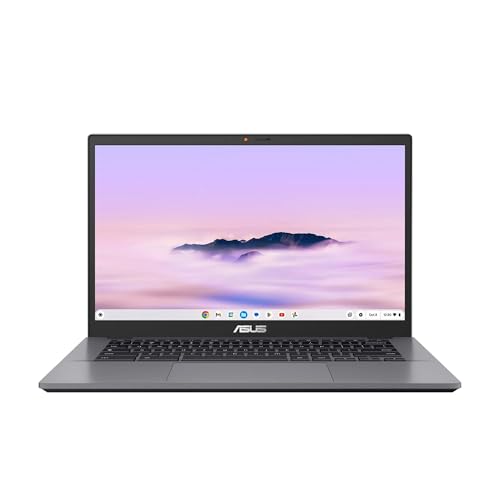
Hits every Chromebook Plus minimum — a 12th-gen Core i3, 8GB, 128GB, a Full HD IPS panel — at the cheapest point that certification is sold, with security updates running to June 2032.
- Intel Core i3-1215U
- 8GB RAM
- 128GB storage
- Updates to June 2032
What’s Inside
- 1 – Chromebook Buyer's Guide
- 2 – Chromebook Comparison Table
- 3 – Best Chromebooks in 2026 — Reviews
- 3.1 – 1. Lenovo Chromebook Duet 11-inch (Cheapest)
- 3.2 – 2. ASUS Chromebook Flip CX1 (Budget Durable)
- 3.3 – 3. ASUS Chromebook Plus CX34 (Best Value Chromebook Plus)
- 3.4 – 4. Lenovo IdeaPad Flex 5i Chromebook Plus (Best 2-in-1 Touchscreen)
- 3.5 – 5. Lenovo Chromebook Plus 14 (Best Display and RAM)
- 3.6 – 6. Acer Chromebook Plus Spin 714 (Premium Convertible)
- 4 – Recommended Accessories
- 5 – Which Chromebook Should You Buy?
- 6 – Chromebook FAQ
- 7 – Final Thoughts on Chromebooks
Chromebook Buyer’s Guide
Auto Update Expiration Dates
Every Chromebook has a date after which Google stops shipping it security and feature updates, called Auto Update Expiration. The machine keeps working; it stops being patched. Google’s 2023 announcement set the window at 10 years measured from the platform’s release date, not the device’s — so a laptop that reached shelves in 2024 on a board that launched in 2022 expires in 2032, not 2034. That gap is why the date has to be looked up per model rather than estimated from the year you bought it.
Google’s Auto Update policy page carries the full device table, searchable by the name printed on the machine. For a used or heavily discounted unit that is the first thing to check, because a Chromebook two years from expiry looks identical to one with eight years left.
The six picks below, as Google’s table lists them: Lenovo Chromebook Plus (14″, 10) — June 2035. Acer Chromebook Plus Spin 714 (CP714-1H) and Lenovo Chromebook Duet (11″, 9) — June 2034. ASUS Chromebook Plus CX34 and Lenovo IdeaPad Flex 5i Chromebook Plus (14″, 7) — June 2032. ASUS Chromebook Flip CX1 — June 2031. Two of the four Chromebook Plus models here expire before the cheapest uncertified one does.
What Chromebook Plus Certification Covers
Chromebook Plus is a hardware floor, and the floor is the useful part. Google requires an Intel Core i3 12th generation or above, or an AMD Ryzen 3 5000 series or above, 8GB of RAM, 128GB of storage, a 1080p webcam with temporal noise reduction, and a Full HD IPS display or better. Buying into the certification rules out the 4GB, 32GB-storage configurations that still circulate at the bottom of the category.
It does not extend the update window. Google’s Chromebook Plus requirements page says nothing about Auto Update Expiration, and the 10-year policy applies to every platform released from 2021 regardless of badge. The dates above bear that out: the certified CX34 and Flex 5i both expire in June 2032, two years before the uncertified Duet. Treat certification as a specification guarantee and check the expiry date separately.
The software perks attached to the certification are trials, not inclusions. Google’s launch post offers three months of Adobe Photoshop on the web and Adobe Express Premium with a new Chromebook Plus purchase, alongside ChromeOS features such as background blur and noise cancellation on calls. The Adobe access lapses; the hardware floor does not.
Processor and Memory
Browsing, streaming and document editing sit within reach of every chip in this guide, including the two-core Celeron in the CX1. Memory is where the difference shows up. As a practical rule of thumb, 8GB is the working floor: a dozen or more tabs, a video call and two or three Android apps resident at once is what pushes past 4GB, and 4GB configurations are still sold — including on some listings for the Duet below. Read the RAM figure on the individual listing rather than the model name, because several of these models ship in both.
Storage
ChromeOS leans on cloud storage, so 64–128GB fits a browsing-and-documents pattern. Offline media, downloaded Android apps and locally stored project files are what fill it. An SD card slot, common across this category, adds capacity later at a fraction of the cost of buying up front — but a card is slower than internal storage, so it suits archives and media rather than the apps you open daily. Several listings advertise a combined figure that counts a bundled SD card toward the total; the internal number is the one that matters for app performance.
What Chromebooks Still Cannot Do
ChromeOS runs no installed Windows or macOS software, which rules out desktop Photoshop, the installed Microsoft Office suite, and locally installed PC games. The browser-based substitutes are real applications rather than viewers, but they are narrower: Photoshop on the web carries a subset of the desktop tool set, and Adobe Express is a design tool rather than a photo editor. If one Windows- or Mac-only application is load-bearing for your work, no Chromebook in this guide changes that.
Chromebook Comparison Table


Last update on 2026-10-21 / Affiliate links / Images from Amazon Product Advertising API
Best Chromebooks in 2026 — Reviews
Six machines, each with its expiry date checked against Google’s device table — an 11-inch detachable at one end, a 400-nit OLED at the other.
1. Lenovo Chromebook Duet 11-inch (Cheapest)
Cheapest
Last update on 2026-10-21 / Affiliate links / Images from Amazon Product Advertising API
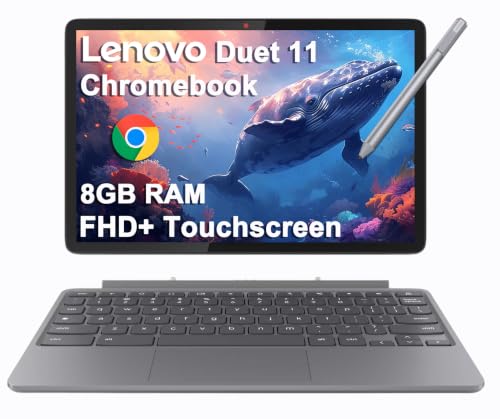
- ProcessorMediaTek Kompanio 838
- RAMUp to 8GB
- StorageeMMC/UFS
- Display11-inch, detachable folio design
- OSChromeOS
- Battery29Wh, 12h rated
The keyboard detaches completely, which is the point of the folio design: an 11-inch slate for reading and video, a keyboard when there’s typing to do, and no hinge to shear off if a child drops it.
Google’s table lists this generation — Chromebook Duet (11″, 9) — as expiring in June 2034, later than either of the mid-priced Chromebook Plus models further down. For a device bought as a spare or handed to a nine-year-old, that is a longer runway than the price suggests.
Notebookcheck measured 423 nits at maximum brightness on the 11-inch panel and reported ten to twelve hours of battery from the 29Wh cell, against Lenovo’s 12-hour rating. The same review found the Kompanio 838 behind entry-level x86 processors on compute, and described the folio keyboard as short on travel and feedback, less suited to long writing sessions. Neither observation is surprising at this size; both decide whether it works as a primary machine or a second one.
Check the memory figure before ordering. Several Duet Gen 9 listings ship 4GB rather than 8GB, and 4GB is where the tab-and-Android-app pattern described above runs out.
Pros
- Updates to June 2034 — later than two of the Chromebook Plus picks here
- Keyboard detaches fully for tablet use
- 423 nits measured by Notebookcheck, bright for an 11-inch budget panel
Cons
- Kompanio 838 sits behind entry-level x86 chips on compute
- Folio keyboard has short travel and little feedback for long typing
- Several listings ship 4GB, not 8GB — check the configuration
2. ASUS Chromebook Flip CX1 (Budget Durable)
Budget Durable

Last update on 2026-10-22 / Affiliate links / Images from Amazon Product Advertising API
- ProcessorIntel Celeron N4500
- RAM8GB
- Storage128GB eMMC
- Display14-inch FHD NanoEdge touchscreen, 360-degree hinge
- OSChromeOS
- Battery11 hours rated
This is the shortest update window in the guide. Google lists the CX1400FKA and CX1500FKA as expiring in June 2031 — just under five years from now, and three years short of the Duet and the Spin 714. At a budget price that may still be the right trade, but it is the number to weigh against the discount, because the discount is often what makes this model attractive in the first place.
The chassis is what the money goes into instead. ASUS puts it through the US MIL-STD 810H standard and fits a 360-degree hinge, so it folds into tent and tablet positions — an uncommon pairing at this end of the category.
The Celeron N4500 is two cores and two threads, which suits a handful of tabs and a document rather than a dozen tabs alongside a video call. ASUS also rates the 14-inch panel at 45% NTSC coverage with a glossy finish, so color is thin and reflections are a factor near a window. The 8GB of LPDDR4X is soldered and 8GB is the maximum the platform accepts.
Pros
- MIL-STD 810H tested by ASUS
- 360-degree hinge and touchscreen at a budget price
- 8GB standard rather than the 4GB common at this tier
Cons
- Updates end June 2031 — the shortest window in this guide
- Lowest core count in this guide, and 8GB is the platform maximum
- 45% NTSC glossy panel — thin color, reflective near a window
3. ASUS Chromebook Plus CX34 (Best Value Chromebook Plus)
Best Value Chromebook Plus
Last update on 2026-10-22 / Affiliate links / Images from Amazon Product Advertising API
- ProcessorIntel Core i3-1215U
- RAM8GB
- Storage128GB
- Display14-inch FHD, NanoEdge
- OSChromeOS (Chromebook Plus certified)
- Battery10h rated
The CX34 sits at the certification floor on every axis: the i3-1215U, 8GB and 128GB are exactly Google’s minimums, and the panel is Full HD IPS as required. Nothing here exceeds the specification, which is the trade — the certification’s whole function is guaranteeing those numbers at the cheapest price they can be had for.
PCWorld ran this configuration past twelve hours on its web-based battery benchmark, two hours beyond ASUS’s 10-hour rating, and found the screen brighter in use than the 250 nits ASUS quotes. The same review was unimpressed by the audio: the speakers fire downward, into a desk or a lap depending on where the machine sits, which is workable for calls and thin for anything else without headphones.
The update window is June 2032, per Google’s table — just under six years from now, and the same date as the Flex 5i below. The badge on the lid says nothing about that date, so the case for this machine rests on what it costs against the specification it guarantees, not on how long it lasts.
Pros
- Meets the full Chromebook Plus floor — i3-1215U, 8GB, 128GB, FHD IPS
- Over twelve hours on PCWorld’s battery benchmark, beating its 10-hour rating
- Updates run to June 2032, a year past the uncertified CX1
Cons
- Updates end June 2032 — two years earlier than the cheaper Duet
- Downward-firing speakers PCWorld found lacking
- Non-touch display, and 8GB/128GB is the certification minimum, not a step above it
4. Lenovo IdeaPad Flex 5i Chromebook Plus (Best 2-in-1 Touchscreen)
Best 2-in-1 Touchscreen
Last update on 2026-10-22 / Affiliate links / Images from Amazon Product Advertising API
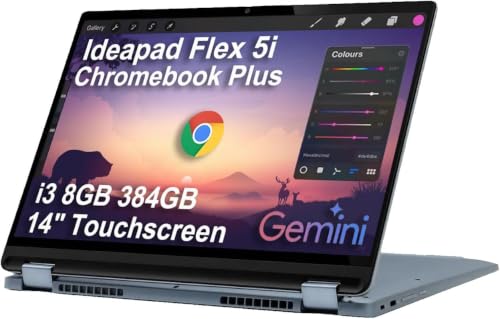
- ProcessorIntel Core i3-1315U (6-core)
- RAM8GB
- Storage256GB (SSD + SD card)
- Display14-inch FHD+ touchscreen, 360-degree hinge
- OSChromeOS (Chromebook Plus certified)
- BatteryUp to 10 hours rated
A 360-degree hinge on a certified machine is what separates this from the CX34: same June 2032 expiry per Google’s table, same 8GB, a step up to the six-core i3-1315U, and a screen that folds back for reading or props into tent mode for video.
PCWorld found a physical shutter on the webcam — a mechanical cover rather than a software toggle, which is the version that survives a compromised browser tab. That review also recorded a little over nine hours of battery, weighed the machine at 3.52 lbs, and noted there is no HDMI output, only a microSD reader.
Nine hours is the shortest measured runtime among the picks tested here, and 3.52 lbs is heavy for a 14-inch convertible that gets held in tablet mode. Both are the cost of the hinge. Note also that PCWorld’s review unit carried 128GB of internal storage: listings advertising 256GB reach that figure by counting a bundled SD card, so read the internal SSD number separately.
The USI stylus is not in the box.
Pros
- 360-degree hinge and touchscreen on a Chromebook Plus machine
- Physical webcam shutter confirmed by PCWorld
- Six-core i3-1315U, a step above the certification floor
Cons
- Just over nine hours measured by PCWorld — the shortest here
- 3.52 lbs, heavy to hold in tablet mode; no HDMI output
- Updates end June 2032, and the stylus is sold separately
5. Lenovo Chromebook Plus 14 (Best Display and RAM)
Best Display and RAM
Last update on 2026-10-22 / Affiliate links / Images from Amazon Product Advertising API
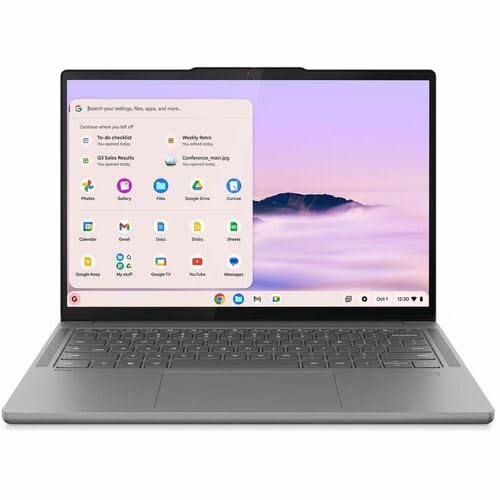
- ProcessorMediaTek Kompanio Ultra 910
- RAMUp to 16GB LPDDR5
- StorageUp to 256GB UFS
- Display14-inch WUXGA OLED, 400 nits, touch
- OSChromeOS (Chromebook Plus certified)
- Battery60Wh, up to 17h rated
June 2035 on Google’s table is the latest expiry date of the six, and this is the only pick whose listed configuration ships 16GB. Almost nine more years of patches and double the memory of the certification floor point the same way: this is the one that stays current longest, in both senses.
Lenovo’s datasheet specifies a 1920×1200 OLED rated at 400 nits, a 60Wh battery, MIL-STD-810H testing, and a starting weight of 2.58 lbs. OLED here means per-pixel black rather than a backlit panel behind an LCD; the 400-nit figure is what to compare against the 340 nits Acer quotes for the Spin 714.
PCWorld recorded 19 hours on CrXPRT 2, two hours past Lenovo’s own 17-hour claim, and called the Dolby-certified speakers shockingly loud and punchy — they fire upward rather than into the desk, unlike the CX34’s. That review found the keyboard comfortable over long typing sessions but the function-key row too small to read without leaning in, and read the Speedometer 3.1 result as a sign the Kompanio Ultra 910 could struggle under heavy multitasking, which is worth weighing against the 16GB.
Pros
- Updates to June 2035 — the latest date of the six picks here
- 16GB LPDDR5, double the Chromebook Plus floor
- 400-nit WUXGA OLED touchscreen and 19 hours measured by PCWorld
Cons
- PCWorld’s Speedometer 3.1 result points to limits under heavy multitasking
- Function keys too small to read comfortably, per PCWorld
- Fixed clamshell — no 360-degree hinge like the Flex 5i or Spin 714
6. Acer Chromebook Plus Spin 714 (Premium Convertible)
Premium Convertible
Last update on 2026-10-21 / Affiliate links / Images from Amazon Product Advertising API
- ProcessorIntel Core Ultra 5 115U (8-core)
- RAM8GB (16GB config available)
- Storage256GB (512GB config available)
- Display14-inch WUXGA touchscreen, 360-degree convertible
- OSChromeOS (Chromebook Plus certified)
- Battery10 hours rated
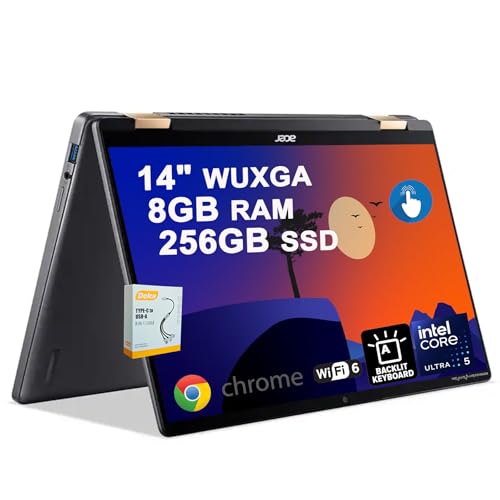
Eight cores of Core Ultra 5 115U against the Flex 5i’s six and the CX1’s two, and a June 2034 expiry — two years beyond the two mid-priced certified picks above. Acer specifies MIL-STD 810H testing, a 340-nit WUXGA panel at 100% sRGB, and a stylus garage that stores and charges an Active Stylus.
Whether that stylus arrives with the machine depends on the SKU. PCWorld’s CP714-1H review unit — the same Core Ultra 5 115U, 8GB, 256GB configuration listed here — shipped without one, and the review says so plainly: buy the pen separately. Confirm what a given listing includes rather than assuming the garage comes filled.
That review also measured 15.1 hours on CrXPRT against Acer’s 10-hour rating, while noting that around 10 hours matched ordinary day-to-day use more closely — a useful reminder that a benchmark loop and a working day are different tests. One handling detail: the stylus cannot be pulled from its garage once the screen is folded into tablet mode, so it has to come out first.
The 8GB base configuration is the thing to look past. A 16GB option exists, and on a machine bought for a June 2034 expiry, memory is the specification most likely to date before the patches stop.
Pros
- Core Ultra 5 115U — eight cores, against six on the Flex 5i and two on the CX1
- Updates to June 2034, two years past the CX34 and Flex 5i
- MIL-STD 810H tested, 340-nit 100% sRGB panel, 15.1 hours on PCWorld’s CrXPRT run
Cons
- Stylus inclusion varies by SKU — PCWorld’s unit arrived without one
- 8GB in the base configuration, with the 16GB option sold separately
- Stylus must be removed before folding into tablet mode
Recommended Accessories


Last update on 2026-10-21 / Affiliate links / Images from Amazon Product Advertising API
Which Chromebook Should You Buy?
| Best For | Pick |
|---|---|
| Cheapest | Lenovo Chromebook Duet 11-inch |
| Budget Durable | ASUS Chromebook Flip CX1 |
| Best Value Chromebook Plus | ASUS Chromebook Plus CX34 |
| Best 2-in-1 Touchscreen | Lenovo IdeaPad Flex 5i Chromebook Plus |
| Best Display and RAM | Lenovo Chromebook Plus 14 |
| Premium Convertible | Acer Chromebook Plus Spin 714 |
Chromebook FAQ
How do I find a Chromebook’s AUE date without buying it first?
Two routes. On a machine you already have, open Settings, then About ChromeOS, then Additional details — the update schedule is printed there. Before buying, search Google’s Auto Update policy page for the name on the lid. The catch is that Google’s table uses the manufacturer’s platform name, which is not always the name on the retail box: the Duet in this guide is listed as “Chromebook Duet (11″, 9)” and the Acer as “Chromebook Plus Spin 714 (CP714-1H, CP714-1HN, CPE794-1, CPE794-1N)”. Match the model number on the underside of the machine or in the listing, not the marketing name.
Does Chromebook Plus certification mean a longer update window?
No — the two are unrelated. Certification is not even fixed at the factory: Google lists existing Chromebooks that already meet the hardware bar and gain Chromebook Plus features through a ChromeOS update, so a machine can acquire the badge after purchase without its expiry date moving by a day. Check the badge and the date as two separate questions, in that order.
What happens on the day a Chromebook hits its AUE date?
Nothing visible. The device boots, the browser opens, installed apps keep running. What stops is the flow of security patches to ChromeOS and the bundled version of Chrome, so newly discovered browser vulnerabilities stay unpatched from that day forward. That is why an expired Chromebook is a poor choice for anything involving banking, email or work accounts, and a reasonable one for offline media on a home network.
Can I run Photoshop or Microsoft Office on a Chromebook?
Not the installed versions, and for Office the route is narrower than people expect: Microsoft withdrew its Android Office apps from ChromeOS in 2021 and directed users to office.com, so the web app is the only first-party option. The web versions cover ordinary document, spreadsheet and slide work; where they run out is macro-heavy Excel workbooks, large files edited offline, and anything relying on desktop add-ins. Photoshop on the web has the same shape of limitation — no third-party plugins and no color-managed print workflow.
Are Chromebooks good for gaming?
For cloud streaming through GeForce NOW or Xbox Cloud Gaming, the machine barely matters — those run in the browser, and the bottleneck is your connection’s latency and stability rather than the processor. Locally installed PC games need Windows or macOS. If cloud gaming is the plan, spend on the screen and the Wi-Fi radio rather than the chip.
Is 8GB enough, or should I stretch to 16GB?
8GB covers the pattern most people describe as heavy: twenty-odd tabs, a video call, a couple of Android apps. The case for 16GB comes down to habit — leaving tabs open across days rather than closing them, or running Linux applications through ChromeOS’s container. The stronger argument for 16GB is timing — memory is soldered on all six machines here, so it is decided at purchase and cannot be revisited, unlike storage, which an SD card extends.
Final Thoughts on Chromebooks
Look up the expiry date before the specification sheet. It is the one number on a Chromebook that cannot be upgraded, worked around, or improved by spending more — and as the June 2031 through June 2035 spread across these six shows, it does not follow price or certification. Once the date is acceptable, Chromebook Plus certification settles the specification floor, and memory is the part to decide at purchase, because every machine here solders it.
If a Chromebook is under consideration against a Windows laptop for a child, our guide to laptops for tweens covers that comparison in more depth.