Citrix’s system requirements page for the Workspace app on Windows lists a minimum of 2 GB of RAM. The same page carries a line that decides more purchases than any specification on it: “Citrix Workspace app for Windows is supported only in emulator mode on the Windows ARM64 operating system.”
Platform support narrows this category long before processor speed does — which client Citrix publishes for your operating system, what your organization’s security policy requires, and how you get on the network. Policy and network access settle more here than hardware does, across seven current laptops for different Citrix setups in 2026.
Editor’s Pick
Last update on 2026-10-17 / Affiliate links / Images from Amazon Product Advertising API
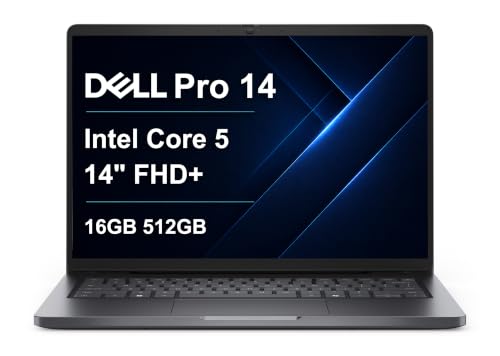
A gigabit Ethernet jack for a wired session, two SODIMM slots you can reach, and Windows 11 Pro on the listed configuration — the parts that decide anything on a machine whose work happens on a server.
- Intel Core 5 120U
- 16GB DDR5 in two SODIMM slots
- 1GbE RJ-45 and Thunderbolt 4
- MIL-STD-810H tested
What’s Inside
- 1 – Citrix Workspace Laptop Buyer's Guide
- 2 – Citrix Workspace Laptop Comparison Table
- 3 – Best Laptops for Citrix Workspace, Reviewed
- 3.1 – 1. Dell Pro 14 (PC14250) (Best Overall)
- 3.2 – 2. HP OmniBook 5 Flip (Best Budget)
- 3.3 – 3. Microsoft Surface Laptop 13.8" (Snapdragon X2) (Best for Security on ARM)
- 3.4 – 4. Apple MacBook Air 13-inch (M5) (Best for Mac Users)
- 3.5 – 5. Acer Chromebook Plus Spin 714 (Best Chromebook)
- 3.6 – 6. Lenovo ThinkPad X1 Carbon Gen 13 Aura Edition (Best Premium)
- 3.7 – 7. Lenovo ThinkPad E16 Gen 2 (Best for Multi-Monitor Setups)
- 4 – Recommended Accessories
- 5 – Which Citrix Workspace Laptop Should You Buy?
- 6 – Citrix Workspace Laptop FAQ
- 7 – Final Thoughts on Citrix Workspace Laptops
Citrix Workspace Laptop Buyer’s Guide
Desktop virtualization puts the computing on a server and leaves your laptop holding a session window. Lose the laptop and you log in from another one. That arrangement is why the client-side requirements are as low as they are, and why the specification that shapes your day is rarely the processor.
What the Workspace App Requires
Two sets of requirements get mixed up constantly: the Citrix server infrastructure hosting the virtual desktops, which runs on server hardware you will never buy, and the Workspace app, which is a client. You are buying for the client.
2 GB of RAM and 1 GB of free disk space — Citrix’s published minimum for the Workspace app on Windows. Every laptop below clears that several times over, so compatibility is not the question. What the extra memory buys is room for the browser, the Teams call and the local applications running beside the session.
For everyday use alongside a session, a Core i5 or Ryzen 5-class processor with 8GB of RAM and 256GB of storage is enough. Move up to 16GB or 32GB when your local work needs it — video editing, CAD, a local virtual machine. Citrix never asks for it.
Which Platforms Citrix Workspace Runs On
Citrix publishes separate clients for Windows, macOS, Linux, ChromeOS, iOS and Android, plus an HTML5 client that runs in Safari, Chrome, Edge or Firefox. Three details in that documentation change what a given laptop is worth to you.
- Windows on ARM64. The Windows client is documented as supported in emulator mode on ARM64. A native ARM64 build exists and is newer — see the section below.
- macOS. Citrix supports the current macOS release and the two before it — Tahoe 26, Sequoia 15 and Sonoma 14 at the time of writing. A Mac that stops receiving macOS updates drifts out of that window.
- ChromeOS. There is a dedicated Citrix Workspace app for ChromeOS, added from the Chrome Web Store and shipped on its own release train, separate from the HTML5 browser client. A Chromebook is not restricted to the browser version.
Network Connection and Wired Ethernet
The session is rendered on a server and streamed to you, so latency and packet loss show up as lag in the pointer and in typing rather than as a slow application. A wired connection removes the most common source of both. Of the picks below, the Dell Pro 14 and the ThinkPad E16 have a built-in RJ-45 jack; the rest need a USB-C adapter.
App Protection on ARM64 Windows
From Citrix Workspace app for Windows version 25.7.0, App Protection is supported on devices with the Arm64 edition of Windows — the layer that blocks screen capture and keylogging during a session, previously an x86-only feature. Citrix’s release notes describe that as App Protection running with the app in emulated mode. The native ARM64 build is a separate and later thing: Citrix’s ARM64 FAQ places it in Tech Preview at Workspace app 2603 CR, sets general availability at 2607 LTSR, and states that App Protection, browser content redirection and deviceTrust run natively on that build. If your organization mandates App Protection, ask which version your administrators deploy before buying an ARM laptop — this is a status that moves.
Do You Need a Discrete GPU?
Not for the session. Rendering happens on the server and arrives as an encoded stream, so a discrete GPU changes nothing about how a virtual desktop behaves. It only matters for graphics work you run locally, outside Citrix. The same reasoning applies to 32GB of RAM, a 2.8K OLED panel and a Thunderbolt dock: buy those for the work that happens on the laptop, not for the work that happens on the server.
Citrix Workspace Laptop Comparison Table


Last update on 2026-10-17 / Affiliate links / Images from Amazon Product Advertising API
Best Laptops for Citrix Workspace, Reviewed
Seven machines across Windows, macOS and ChromeOS, sorted by what changes when the heavy computing is happening somewhere else.
1. Dell Pro 14 (PC14250) (Best Overall)
Best Overall
Last update on 2026-10-17 / Affiliate links / Images from Amazon Product Advertising API
- ProcessorIntel Core 5 120U (Core Ultra U-series also offered)
- RAM16GB DDR5, two SODIMM slots
- Storage512GB SSD
- Display14-inch FHD+ (1920×1200) IPS anti-glare
- Battery45Wh or 55Wh
- OSWindows 11 Pro
Dell positions this as the successor to the Latitude 5450, and the port list is where that shows. Dell’s datasheet lists a 1GbE RJ-45 jack alongside Thunderbolt 4, a second USB-C, two USB-A ports and HDMI 2.1. For a remote session, that wired jack does more for how the desktop feels under your hands than any processor in the configuration list.
LaptopMedia measured 336 nits and 51% sRGB coverage on its review unit’s panel, with a 1240:1 contrast ratio and 10 hours 44 minutes in a video-playback battery test. That review ran a Core Ultra 7 265U rather than the Core 5 120U here, but the panel finding is the one that carries: Dell’s datasheet lists a 300-nit 45% NTSC screen, a 300-nit 100% sRGB screen and a 400-nit 100% sRGB screen in the same chassis. Eight hours a day inside a session window is a long time to spend with the first of those, so check which panel a listing ships before ordering.
The same review found two user-accessible SODIMM slots, which makes memory something you add later instead of a decision fixed at checkout — one of only two picks here where that is true. MIL-STD-810H testing runs across the line, and the listed configuration ships Windows 11 Pro. Dell offers both Home and Pro on this model, and BitLocker management and Group Policy live in Pro, so check the edition on any other listing if your VDI setup depends on them.
Pros
- 1GbE RJ-45 jack and Thunderbolt 4 in the chassis
- Two user-accessible SODIMM slots, found by LaptopMedia
- MIL-STD-810H tested across the line
- Windows 11 Pro on the listed configuration
Cons
- Entry panel measured 336 nits and 51% sRGB
- LaptopMedia’s test unit was a Core Ultra 7 265U, not the Core 5 120U base
2. HP OmniBook 5 Flip (Best Budget)
Best Budget

Last update on 2026-10-17 / Affiliate links / Images from Amazon Product Advertising API
- ProcessorIntel Core 5 120U
- RAM8GB LPDDR5-5200, onboard
- Storage512GB PCIe Gen4 SSD
- Display14-inch 1920×1200 IPS touch, 300 nits
- Battery68Wh
- OSWindows 11
Against a 2 GB requirement, an entry-tier Windows laptop is already several times more machine than the Workspace app needs, and this one is built around the two things that still change: battery and a hinge. HP’s product sheet for the 14-fp0013dx lists a 68Wh battery rated up to 15 hours of general use and up to 21 hours 30 minutes of video playback — HP’s own rating rather than a measured runtime, and video playback is the gentler of the two tests.
The 8GB of LPDDR5 is onboard and non-upgradeable on HP’s own spec sheet, so the amount you buy is the amount you keep. A Workspace session and a browser fit inside it. A session plus thirty tabs and a Teams call is where it runs out, and the answer to that is the 16GB configuration at purchase, not an upgrade later.
The panel is modest to match: 300 nits and 62.5% sRGB. Ports run to two USB-A, two USB-C and HDMI 2.1, with no card reader and no Ethernet jack, so a wired session means a dongle. No independent lab has published a test of this configuration, which leaves the display figures, the battery rating and the hinge resting on HP’s documentation alone.
Pros
- 68Wh battery, rated by HP up to 21 hours 30 minutes of video playback
- Two USB-A, two USB-C and HDMI 2.1
- 1920×1200 IPS touchscreen on a 360-degree hinge
Cons
- 8GB LPDDR5 is onboard and non-upgradeable
- 300 nits and 62.5% sRGB on HP’s own figures
- No independent lab test published for this configuration
- No Ethernet jack and no card reader
3. Microsoft Surface Laptop 13.8″ (Snapdragon X2) (Best for Security on ARM)
Best for Security on ARM

Last update on 2026-10-17 / Affiliate links / Images from Amazon Product Advertising API
- ProcessorSnapdragon X2 Elite (12-core)
- RAM16GB, soldered
- Storage512GB M.2 2230 SSD, replaceable
- Display13.8-inch 2304×1536 IPS touch, 120Hz, 3:2
- BatteryUp to 20 hours video playback (Microsoft)
- OSWindows 11 (Copilot+ PC)
If your organization enforces App Protection, Citrix’s compatibility matrix now lists Arm64 Windows from Workspace app 25.7.0 — a line that was not there a year ago, and the reason an ARM laptop can enter this conversation at all. What it does not yet mean is a native client: on Citrix’s own timeline the ARM64 build reaches general availability at 2607 LTSR, and until administrators deploy that build the Workspace app runs here through Windows’ x86 emulation. It works, and Citrix documents it as the supported arrangement, but it is the version number rather than the laptop that settles what you get.
Notebookcheck measured 623 cd/m² average brightness and a 1402:1 contrast ratio on the 13.8-inch 120Hz IPS touchscreen, with no PWM flicker, and described the illuminated keyboard as comfortable to type on and the haptic trackpad as working well. That review covers the Snapdragon X2 Plus configuration in the same 2026 chassis; the pick here is the 12-core X2 Elite, so the panel and input findings carry across and the processor results do not.
Microsoft rates the 13.8-inch model at up to 20 hours of video playback and up to 16 hours of web browsing, and its specification page puts the enclosure at 64% recycled aluminum alloy in the A cover and C bucket. The 16GB is soldered; the 512GB M.2 2230 SSD is not, and Notebookcheck found it swappable. There is a fan, quiet in that review rather than absent.
Pros
- App Protection listed for Arm64 Windows from Workspace app 25.7.0
- 623 cd/m² average brightness measured by Notebookcheck
- Microsoft rates up to 20 hours of video playback
- Replaceable M.2 2230 SSD
Cons
- Workspace app runs under x86 emulation until the native ARM64 build reaches general availability
- RAM is soldered at 16GB
- Notebookcheck’s review unit was the X2 Plus, not the X2 Elite
4. Apple MacBook Air 13-inch (M5) (Best for Mac Users)
Best for Mac Users
Last update on 2026-10-17 / Affiliate links / Images from Amazon Product Advertising API
- ProcessorApple M5
- RAM16GB unified
- Storage512GB SSD
- Display13.6-inch 2560×1664, 500 nits, P3
- Battery53.8Wh, up to 18 hours video streaming (Apple)
- OSmacOS
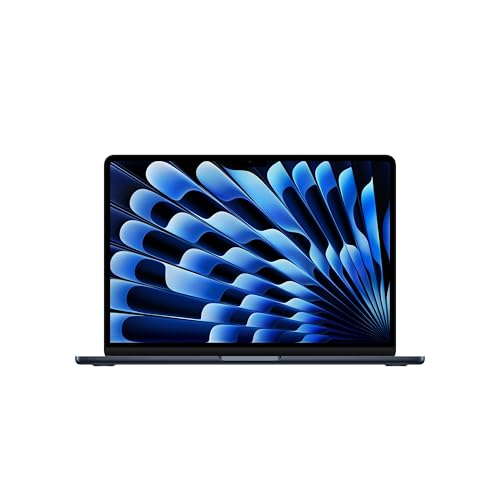
Citrix ships a macOS client, and the constraint on a Mac is not the hardware. Citrix supports the current macOS release and the two before it, so the question to ask about any Mac is how long Apple will keep feeding it macOS updates. On a machine bought new that window is years away; on a hand-me-down it may already be closing.
Apple’s specifications put the 13.6-inch display at 2560×1664 and 500 nits with P3 color, and the battery at 53.8Wh rated up to 18 hours of video streaming and 15 hours of wireless web. BGR’s M5 Air review treats the 18-hour figure as a rating most people will not reach while still describing a full working day from it; that review covers the 15.3-inch model, which shares the chip and the 500-nit P3 panel specification but carries a larger battery.
There is no fan in the Air, so a day of sessions and video calls makes no noise. The trade-off against the Windows picks is management rather than performance: some corporate Citrix deployments lean on Windows-specific tooling, so confirm macOS is in scope for your environment before buying.
Pros
- Citrix publishes a macOS client, supported on the current release and the two before it
- Fanless and silent through a full day of sessions
- 500-nit P3 display and 53.8Wh battery on Apple’s figures
Cons
- Citrix’s macOS support window is only three releases wide
- Confirm your deployment supports macOS before buying
- Fewer ports than the Windows picks, and no Ethernet jack
5. Acer Chromebook Plus Spin 714 (Best Chromebook)
Best Chromebook
Last update on 2026-10-17 / Affiliate links / Images from Amazon Product Advertising API
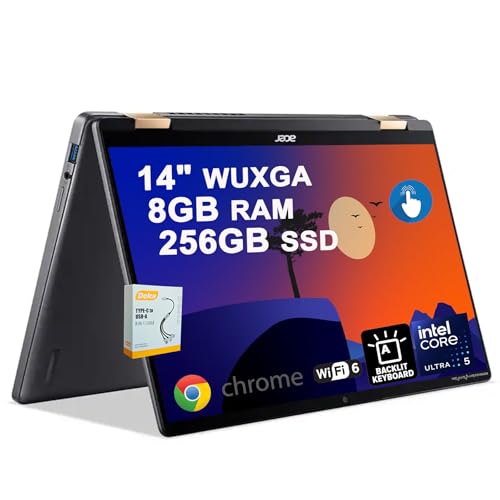
- ProcessorIntel Core Ultra 5 115U
- RAM8GB LPDDR5
- Storage256GB SSD
- Display14-inch WUXGA IPS touch, 100% sRGB, 360-degree
- BatteryUp to 10 hours (Acer)
- OSChromeOS (Chromebook Plus)
ChromeOS is a first-class Citrix platform rather than a browser workaround. Citrix publishes a dedicated Workspace app for ChromeOS, installed from the Chrome Web Store and shipped on its own release train, and the HTML5 client is available in Chrome as well. A Chromebook gets both routes into a session, not just the browser one.
Acer’s specification sheet lists a fingerprint reader with on-chip matching for ChromeOS, a discrete H1 Trusted Platform Module and MIL-STD-810H testing, alongside two Thunderbolt 4 ports and a 100% sRGB panel. Laptop Mag measured 355 nits and 78.7% DCI-P3 coverage on the Core Ultra 5 115U configuration and recorded 9 hours 30 minutes on its battery test — the same processor and memory as the pick here, short of Acer’s 10-hour rating but close to it.
The stylus stores and charges in a garage cut into the chassis, and the hinge folds the screen back flat, which suits annotating a document beside a session. 8GB is the ceiling on this configuration; Acer offers up to 16GB on the model, but not on this one, and ChromeOS memory is soldered either way.
Pros
- Citrix publishes a native ChromeOS client as well as the HTML5 one
- Fingerprint reader with on-chip matching and a discrete H1 TPM
- 355 nits and 78.7% DCI-P3 measured by Laptop Mag
- MIL-STD-810H tested, with an in-chassis stylus garage
Cons
- 8GB is the ceiling on this configuration and it is soldered
- 9 hours 30 minutes on Laptop Mag’s test, under Acer’s 10-hour rating
6. Lenovo ThinkPad X1 Carbon Gen 13 Aura Edition (Best Premium)
Best Premium

Last update on 2026-10-17 / Affiliate links / Images from Amazon Product Advertising API
- ProcessorIntel Core Ultra 7 258V
- RAM32GB LPDDR5X, packaged with the CPU
- Storage2TB SSD
- Display14-inch 2.8K OLED, 120Hz
- BatteryNot published by Lenovo for this configuration
- OSWindows 11 Pro
Almost nothing on this specification sheet is here for Citrix. 32GB against a 2 GB minimum, a 2.8K OLED panel and a Core Ultra 7 258V are bought for whatever runs beside the session — a large local dataset, a second application stack, a dozen windows behind the Workspace one. For session access on its own, the Dell and the OmniBook above do the same job.
What the money does buy is the surface you look at. Notebookcheck’s review of the 21NS0010GE — Core Ultra 7 258V, 32GB, 1TB — measured 410 cd/m² on the 2880×1800 120Hz OLED with 100% sRGB and 99.5% DCI-P3 coverage, and 1.5mm of key travel. Set that against the 51% sRGB entry panel on the Dell and the gap is the whole argument for this pick.
The same review names what the price does not fix: a 1080p webcam it rates as low quality, no 64GB option on this generation, and SSD throttling under sustained load. Memory is LPDDR5X packaged with the processor, so 32GB is the ceiling as well as the starting point — a machine you keep at this specification rather than grow into it.
Pros
- 410-nit OLED with 100% sRGB and 99.5% DCI-P3, measured by Notebookcheck
- 1.5mm key travel measured on the same unit
- 32GB LPDDR5X standard for local work beside the session
Cons
- Every specification above the Citrix minimum is there for local work, not the session
- 32GB is the ceiling — memory is packaged with the CPU
- Notebookcheck rates the 1080p webcam low quality and found SSD throttling under load
7. Lenovo ThinkPad E16 Gen 2 (Best for Multi-Monitor Setups)
Best for Multi-Monitor Setups
Last update on 2026-10-17 / Affiliate links / Images from Amazon Product Advertising API
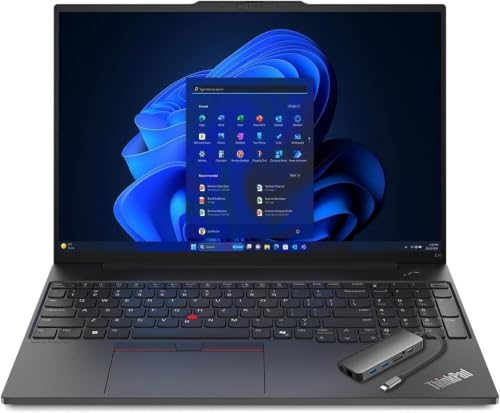
- ProcessorAMD Ryzen 7 7735HS (Ryzen 3 and 5 options also offered)
- RAM16GB DDR5, two SODIMM slots to 64GB
- StorageTwo M.2 PCIe 4.0 slots
- Display16-inch WUXGA IPS (WQXGA also offered)
- Battery47Wh or 57Wh
- OSWindows 11 Pro
A Citrix session that lives on a desk usually lives across more than one screen. Lenovo’s specification sheet for the E16 Gen 2 AMD documents up to four independent displays — the built-in panel plus three external monitors over HDMI and USB-C — with HDMI 2.1 driving 4K at 60Hz and the 10Gbps USB-C port driving 5K at 60Hz. That is a stated display-controller limit rather than an inference from how many video outputs are on the chassis, which is the usual basis for a multi-monitor claim.
The same sheet lists two DDR5 SODIMM slots taking 64GB, two M.2 slots, an RJ-45 jack, MIL-STD-810H testing, a 47Wh or 57Wh battery rated up to 12.68 hours on MobileMark 25, and three panel choices: 300 nits at 45% NTSC, 400 nits at 100% sRGB, and a 400-nit WQXGA. On a desk you sit at all day the entry panel is the one to pass over.
All of that comes from Lenovo’s documentation. LaptopMedia’s E16 Gen 2 review covers the Intel configurations — Core Ultra 5 125U through Ultra 7 155H — rather than the Ryzen 7 7735HS here, and no independent lab has benchmarked the AMD version. The 16-inch chassis is also the only one this size in the guide, which points it at a fixed desk rather than a commute.
Pros
- Three external monitors documented by Lenovo — 4K60 over HDMI, 5K60 over USB-C
- Two SODIMM slots to 64GB and two M.2 slots
- RJ-45 Ethernet jack for a wired session
- MIL-STD-810H tested
Cons
- No independent lab test published for the AMD configuration
- Entry panel is 300 nits at 45% NTSC
- 16-inch chassis is the largest here
Recommended Accessories

Last update on 2026-10-17 / Affiliate links / Images from Amazon Product Advertising API
Which Citrix Workspace Laptop Should You Buy?
| Best For | Pick |
|---|---|
| Overall | Dell Pro 14 (PC14250) |
| Budget | HP OmniBook 5 Flip |
| Security on ARM | Microsoft Surface Laptop 13.8″ (Snapdragon X2) |
| Mac Users | Apple MacBook Air 13-inch (M5) |
| Chromebook | Acer Chromebook Plus Spin 714 |
| Premium | Lenovo ThinkPad X1 Carbon Gen 13 Aura Edition |
| Multi-Monitor Setups | Lenovo ThinkPad E16 Gen 2 |
Citrix Workspace Laptop FAQ
Is Citrix compatible with Mac?
Yes — Citrix publishes a Workspace app for macOS and supports the current release plus the two before it. The consequence lands on older hardware rather than new: once a Mac stops receiving macOS updates, it drifts out of that window within a couple of years, and the HTML5 client in Safari, Chrome or Edge becomes the fallback instead of the native app. If you are buying for a managed environment, ask IT whether their deployment covers macOS clients at all before you spend anything.
What is Citrix Workspace, and how does it work?
It is the client application that connects your device to desktops and applications hosted on a Citrix server. Keystrokes and mouse movement travel up, an encoded image of the desktop comes back. What that means at the till: the processor, GPU and memory running your applications belong to the server, and the ones in your laptop only decode a stream and run whatever you open locally alongside it.
Is Citrix Access Gateway a VPN?
Citrix Access Gateway (CAG) is a remote access product that establishes an encrypted connection between your device and the corporate network, so it does a similar job to a VPN. The difference that matters when buying: a consumer VPN tunnels all your traffic from the operating system outward, while CAG is the front door to a Citrix environment. It does not remove the need for the Workspace app, and it does not change the client-side hardware requirements.
Is Citrix Workspace the same as Citrix Receiver?
Yes. Citrix renamed Receiver to Workspace app in 2018, and Workspace covers everything Receiver did. If a search sends you to a Receiver download page or an IT wiki still using the old name, go to Citrix’s current Workspace app downloads for your operating system instead — Receiver-era installers predate features like App Protection entirely.
Does Citrix Workspace work on ARM-based Windows laptops like the Surface with Snapdragon?
Yes, and two things are worth confirming with your administrators rather than reading off a spec sheet. First, which Workspace app version they deploy: App Protection on Arm64 Windows begins at 25.7.0. Second, whether they have moved to the native ARM64 build, which Citrix schedules for general availability at 2607 LTSR. Before that build, the app runs under Windows’ x86 emulation on an ARM machine, which is Citrix’s own documented arrangement rather than an unsupported workaround.
Do I need a lot of RAM to run Citrix Workspace?
No — Citrix’s published minimum is 2GB, and nothing current ships below 8GB. The question is about the other half of the machine: how much runs outside the session. A browser, a Teams call and a couple of local applications beside a Workspace window fit inside 8GB; add a local virtual machine or a large spreadsheet and 16GB becomes the floor. Check whether the memory is soldered before deciding, because on five of the seven picks here it is — only the ThinkPad E16 and the Dell Pro 14 take user-installed memory.
Final Thoughts on Citrix Workspace Laptops
None of the seven picks above strain against Citrix’s own numbers — every real difference between them is platform, network and policy, not processing power. Once IT confirms the client version, the App Protection build and how the laptop reaches the corporate network, what is left to weigh is the machine itself: chassis size for wherever the work actually happens, and battery life for a day spent mostly inside a session window rather than running local software. Those are questions the reviews above answer pick by pick; Citrix’s requirements page has nothing to say about any of them.