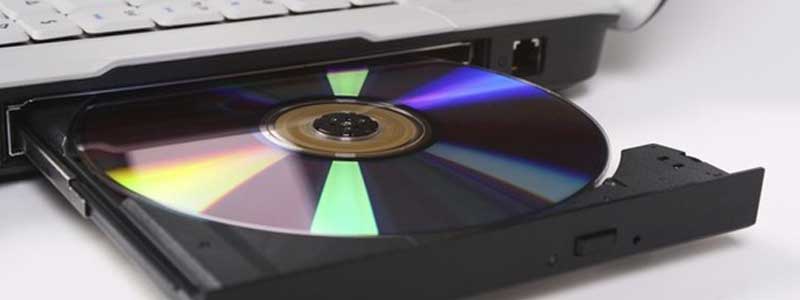
Search “best laptop with a DVD drive” in 2026 and the list comes back short. BGR’s 2026 roundup of laptops you can still buy with a built-in CD/DVD drive names five, and four of them are older models — an HP ZBook 17 G5, a Dell Inspiron 15 5000, a Fujitsu LifeBook A3511 and a ThinkPad E570 — alongside the rugged Panasonic Toughbook 56. BGR also warns that within a series like the Inspiron 15 5000, some configurations have the drive and some don’t, so the spec sheet has to be checked listing by listing.
Shopping for a laptop by its optical drive therefore means shopping from a short list of mostly older machines. The alternative is to buy a current laptop on whatever grounds matter to the work it will do, and add an external writer for the discs. Three of those are below, along with what separates them.
What’s Inside
Why Built-In DVD Drives Are Rare Now
Physical depth is the constraint. A slim tray-loading optical mechanism is roughly 9.5mm tall — the height Provantage lists for the LG drive further down this page — and that is before the tray opening, the surrounding chassis and the board space the drive displaces. A 14-inch thin-and-light has around 15 to 17mm of total thickness to work with, most of which is already spent on battery, board and cooling.
The jobs a disc used to do have also moved. Software arrives as a download, media arrives by stream, and files move on USB storage or through cloud sync. What remains is the archive: old install discs, ripped collections, wedding videos, a decade of backups written to DVD-R. That work happens occasionally, which is exactly the kind of work an accessory suits better than a permanently installed mechanism.
What to Look for in an External DVD or Blu-ray Writer
Three things separate these drives from each other. The first is DVD-only versus Blu-ray. A DVD writer reads and writes CDs and DVDs, which is the whole of what most people need for reading old discs and burning new ones. A Blu-ray writer costs more and adds BD-R and BD-RE, plus the BDXL format that puts up to 128GB on a single disc.
The second is the connector in the box. USB-C plugs straight into a current laptop; a USB-A cable needs an adapter on a machine that has moved entirely to Type-C. Both of these drives ship with a fixed cable, so this is worth checking against the ports on the laptop rather than assuming.
The third is M-DISC. ASUS describes M-DISC as archival-quality storage rated to protect data for up to 1,000 years — a manufacturer rating for a disc that etches a physical layer rather than relying on the light-sensitive dye a standard recordable disc uses. Nobody has verified a thousand-year figure by observation, and no independent lab result establishes one. What is established is the mechanism, and it is a different one. For a set of photos or documents meant to outlive the drive that wrote them, that difference is the reason to want the feature.
Best External DVD and Blu-ray Writers in 2026


Last update on 2026-10-17 / Affiliate links / Images from Amazon Product Advertising API
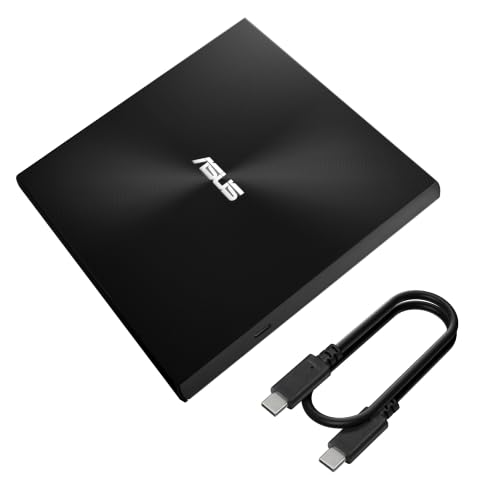
1. ASUS ZenDrive U3M (Best Overall)
Best Overall
Last update on 2026-10-17 / Affiliate links / Images from Amazon Product Advertising API
For reading and burning CDs and DVDs without paying for Blu-ray, this is the drive with the fewest compromises attached to it. ASUS lists the U3M (model SDRW-08U3M-U) at 14mm thick with M-DISC support and a USB 3.2 Gen2x1 Type-C to Type-C cable, and states cross-platform support for Windows and macOS. At 14mm it travels in the same sleeve as the laptop rather than needing its own bag.
That cable is the detail to match against the laptop before ordering: it is right for a machine with only USB-C ports and wrong for an older one with USB-A only, where an adapter becomes part of the kit.
ASUS bundles Power2Go 8 and Nero BackItUp with the drive and marks both as Windows-only. The hardware works on a Mac; the burning and backup software in the box does not, so macOS users are relying on the Finder’s own disc burning or a third-party application. No independent lab test of this model turned up in searching — the figures here are ASUS’s own published specifications.
Pros
- 14mm thick, per ASUS’s specifications
- M-DISC support for archival burning
- USB Type-C cable, no adapter on a current laptop
Cons
- No Blu-ray support — DVD/CD only
- Bundled Power2Go 8 and Nero BackItUp are Windows-only
- Type-C cable needs an adapter on a USB-A laptop
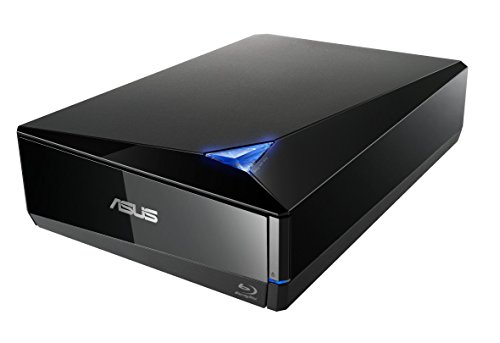
2. ASUS BW-16D1X-U (Best for Blu-ray)
Best for Blu-ray
Last update on 2026-10-17 / Affiliate links / Images from Amazon Product Advertising API
Blu-ray is the reason this drive is here, and BDXL is the part of it that matters for backup rather than movies. ASUS lists 16x Blu-ray writing, BDXL support to 128GB on one disc, M-DISC support, 16x DVD and 40x CD writing, and a USB 3.0 (USB 3.1 Gen1) connection. On burn time, ASUS’s own claim is 10 minutes to back up 25GB at that 16x speed — a manufacturer figure, not a measured one, and one that assumes media rated to run at full speed.
128GB on a single BDXL disc is the specification that changes an archiving routine. A photo library that would take a spindle of DVD-Rs fits on a handful of discs instead, and each disc is one label, one shelf slot and one thing to find again in ten years.
Against that, it costs distinctly more than either DVD-only drive here, and it buys capability that goes unused if the discs in the drawer are CDs and DVD-Rs. Anyone whose disc collection stops at DVD should read the ZenDrive review above instead and keep the difference.
Pros
- Reads and writes BD-R and BD-RE as well as DVD and CD
- BDXL support — up to 128GB on one disc
- 16x Blu-ray, 16x DVD and 40x CD write speeds per ASUS
Cons
- Costs distinctly more than the DVD-only drives here
- Nothing to gain from it if the collection is CDs and DVDs
- Burn-time figure is ASUS’s claim, not a measured result
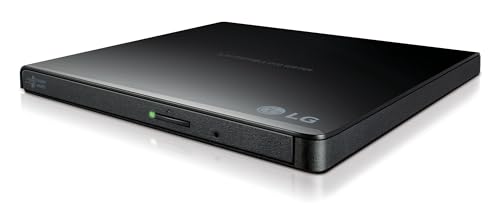
3. LG GP65NB78 (Budget Pick)
Budget Pick
Last update on 2026-10-17 / Affiliate links / Images from Amazon Product Advertising API
This is the entry-priced option of the three, and it keeps M-DISC support at that tier — the cheapest drive in a category is not usually the one that holds on to the archival feature. The retail listing specifies 8x DVD±RW writing, M-DISC support and a USB 2.0 interface; Provantage’s listing gives the height as 9.5mm.
USB 2.0 sounds like the weak point and mostly isn’t, for the work this drive does. Writing a DVD at 8x moves data at about 11MB/s, well inside what USB 2.0’s 480Mbit/s interface carries, so the disc speed sets the pace rather than the cable. The connector is the thing to check: the listing describes USB 2.0 and does not specify a Type-C cable, so a laptop with only Type-C ports likely needs an adapter that the ZenDrive doesn’t.
The evidence base behind this drive is thinner than for the two ASUS models. LG’s own product pages cover the earlier GP65NB60, not this GP65NB78, and searching turned up no review of the NB78 from a testing outlet and no LG datasheet for it. The specifications above come from retail listings. LG’s published macOS support also applies to the GP65NB60 rather than to this model, so a Mac buyer who needs a documented compatibility statement is better served by one of the ASUS drives.
Pros
- Entry-tier price of the three picks here
- M-DISC support at that price
- 9.5mm height, per Provantage’s listing
Cons
- No LG datasheet or independent test for this model number
- Mac compatibility undocumented for the NB78 specifically
- DVD/CD only, no Blu-ray
Which Laptop Should You Pair It With
Any current laptop with a free USB-A or USB-C port will run one of these. That releases the laptop decision from the disc question entirely — the screen, the keyboard, the memory and the battery can be chosen on their own terms. Our buying guides cover current picks across budgets and use cases, and the laptop finder tool narrows the field by requirement.
If You Specifically Want a Built-In Drive
The built-in route is still open, with a cost attached. Of the five machines BGR lists, the ZBook 17 G5, the Inspiron 15 5000, the LifeBook A3511 and the ThinkPad E570 date from 2017 to 2022, so buying one means buying a processor, a display and a battery from that period. The Panasonic Toughbook 56 is the current exception, and it is a rugged machine priced accordingly. Someone burning or reading discs daily, on a desk, may prefer that to carrying an accessory. For occasional disc work, the external drive costs less and doesn’t set the rest of the specification.
External DVD Writer FAQ
Do any current laptops still have a built-in DVD drive?
A handful, but the model name alone won’t tell you which. The variation runs inside a single series: BGR notes that many newer Dell Inspiron 15 5000 configurations have had the drive taken out, while older ones in the same line kept it. Read the port and drive list on the individual listing, and be wary of stock photos, which are frequently reused across configurations that differ on exactly this point.
Is an external DVD drive as good as a built-in one?
The mechanism is the same class of slim drive either way — the 9.5mm format that used to go inside laptops is what sits in these enclosures. The differences are practical. An external drive ties up a USB port and needs somewhere flat to sit while it spins, and a disc can’t be left in it between sessions. Against that, it moves between machines, so one drive serves a laptop, a desktop and a Mac.
Do I need Blu-ray, or is DVD enough?
Sort the disc pile first. CDs, DVD-Rs and old install media all read on a DVD-only drive. The two cases that justify the extra outlay are commercial Blu-ray playback or ripping, and BDXL backup, where one disc stands in for roughly 27 single-layer DVD-Rs — which is a filing and labeling saving as much as a capacity one.
What is M-DISC, and do I need it?
Two things the specification list doesn’t make obvious. First, burning M-DISC media needs an M-DISC-capable drive, but reading it back does not — the discs play in ordinary DVD and Blu-ray drives, so an archive written this way isn’t tied to keeping the same hardware. Second, all three picks here support it, so it isn’t a feature that costs extra within this set. What it does cost is media: M-DISC blanks are priced above standard recordable discs, which is the trade to weigh per disc rather than per drive.
Will an external DVD drive work with my Mac?
ASUS states cross-platform Windows and macOS support for both the ZenDrive U3M and the BW-16D1X-U. The GP65NB78 is the one to check, since LG’s documented macOS support attaches to the earlier GP65NB60. Separate the hardware question from the software one, though: a drive being Mac-compatible says nothing about the burning application, and on macOS that means whatever macOS itself provides or an application bought separately.
Final Thoughts
Choosing a laptop for its optical drive narrows the field to about five machines, four of them several years old. Separating the two purchases removes that constraint: the laptop gets chosen on its screen, keyboard, memory and battery, and a 14mm accessory handles the discs. Of the three drives here, the ZenDrive U3M suits most disc work, the BW-16D1X-U is for Blu-ray and BDXL archiving, and the GP65NB78 is the entry-tier option for anyone who needs M-DISC without the rest.