You have a party in three weeks, a laptop, and no intention of hiring anyone. The good news is that a modern laptop plus one piece of DJ software is genuinely enough to run a room of forty people, and the software you need is either free or costs less than a round of drinks.
The awkward news is that the advice you will find written before about 2024 is mostly wrong now, because the streaming side of DJing has been rebuilt twice. This guide covers what runs on a laptop today, which music sources actually load inside each app, and how to set the night up so it does not fall over.
What’s Inside
- 1 – What a Laptop-Only DJ Setup Can and Cannot Do
- 2 – Laptop Specifications for DJ Software
- 3 – Which Streaming Services Work Inside DJ Software Now
- 4 – Algoriddim djay Pro
- 5 – VirtualDJ
- 6 – Serato DJ Pro and Serato DJ Lite
- 7 – Traktor Pro 4
- 8 – rekordbox
- 9 – Mixxx, the Free Open-Source Option
- 10 – Ableton Live and PCDJ DEX
- 11 – Setting Up and Running the Night
- 12 – Choosing Between the Options
- 13 – Final Thoughts on DJing a Party From a Laptop
What a Laptop-Only DJ Setup Can and Cannot Do
Every mainstream DJ application will run with no hardware attached. You get two or four virtual decks, a crossfader, a mixer, effects and a library browser, all driven with the trackpad and keyboard. For a house party that is a complete setup.
The real limits are about audio routing rather than power. A laptop has one stereo output, so if you send the mix to the speakers you have nothing left to cue the next track in headphones. Some apps work around this by splitting the single stereo output into two mono channels — mix in the left ear, cue in the right — with a splitter cable, which works but sounds worse than a proper two-output setup.
The other limits are practical. One screen means constant window juggling, there is no tactile control so every action is a click, and a laptop that sleeps, updates or pops up a notification mid-set does it in front of everybody.
Do not rely on a streaming service for a live set. Every DJ app that streams requires a live internet connection while you play, and none of them let you cache tracks for offline use. If the venue’s Wi-Fi drops, the deck stops. Download or buy the tracks you actually need and keep them on the laptop’s own drive.
The cheapest upgrade that actually matters
A basic USB audio interface, or an entry-level DJ controller with a built-in sound card, gives you a second independent output so headphone cueing works properly. It is the one purchase that changes what you can do, rather than just making it more comfortable.
Everything else — external monitors, more RAM, a faster drive — makes the evening smoother but does not unlock anything new. If you are running the laptop alongside a TV or projector for visuals, our walkthrough of running a laptop with two monitors covers the display side.
Laptop Specifications for DJ Software
DJ software is far less demanding than its reputation suggests. Native Instruments lists the minimum for Traktor Pro 4 as macOS 13 or Windows 11, an Intel Core i5 and 4GB of RAM.
Two things push those numbers up. Real-time stem separation — splitting a track into vocals, drums, bass and instruments as it plays — is the heaviest feature in any of these apps, and video mixing is heavier still. If you plan to use either, treat the published minimum as irrelevant.
- A current Core i5 / Ryzen 5 or Apple silicon chip is comfortable; anything faster is headroom, not necessity
- 16GB of RAM if you want stems and a large library open at once, 8GB if you do not
- An SSD, not a hard drive — track loading and waveform analysis are both storage-bound
- Enough free space for your music plus the analysis files each app writes alongside it
- At least two USB ports, so a controller and a drive can be connected together
- Windows 11 or a current macOS release — Windows 10 stopped receiving support in October 2025, and the DJ vendors have followed
Battery matters more than people expect. Audio processing keeps the CPU busy for hours, and a laptop that drops into a power-saving profile at 20% will start producing audio dropouts. Plan on running from mains power all night.
Which Streaming Services Work Inside DJ Software Now
This is the part that has changed most, and the part where old guides do the most damage. Streaming integrations are licensing deals, not features, and they appear and disappear when those deals change.
Spotify is the clearest example. It withdrew from DJ software years ago, and then returned in September 2025 — Digital DJ Tips reports it is now available in Serato DJ Pro, rekordbox and djay after years of absence. It did not come back everywhere: DJ TechTools notes that Traktor and VirtualDJ were left out, the integration is desktop-only, and there is no offline mode.
Where things stand across the main apps, per Digital DJ Tips’ streaming roundup:
- rekordbox — TIDAL, Spotify, Apple Music, Beatport, Beatsource and SoundCloud Go+, and uniquely it can have all of them active at once rather than one at a time
- Serato DJ Pro — the same broad list, but only one service connected at a time
- djay Pro — TIDAL, SoundCloud Go+, Beatport, Beatsource, Apple Music and Spotify, across Mac, Windows, iOS and Android
- VirtualDJ — TIDAL, Beatport, Beatsource, Deezer and SoundCloud Go+, with no Spotify or Apple Music
- Traktor Pro — Beatport and Beatsource only, the most limited of the group
Two catches apply regardless of which you use. Every one of these requires a paid subscription to the music service itself on top of the DJ software, and the streamed tracks come with reduced editing — DJ TechTools notes that cue points, hot loops and stems are limited or unavailable depending on the licensing.
Check before you commit to an app. If your entire music collection lives in one streaming service, the integration list above should decide which DJ software you install — not the other way round. These deals have changed several times and can change again.
Algoriddim djay Pro
djay is made by the German developer Algoriddim and runs on Mac, Windows, iPad, iPhone, Android and Vision Pro. It began as a Mac-only application and won an Apple Design Award in 2011 for the iPad version, and a second one in 2016.

Its distinguishing feature is Neural Mix, which separates a playing track into its component parts in real time so you can drop the vocal from one song over the drums of another. Algoriddim describes it as playing and remixing individual elements from multiple tracks live, and it has been in the product since 2020.

On Windows it needs Windows 11 or Windows 10 version 21H1 or later, and supports four decks, DVS, more than 30 effects and over 100 controllers. It is a free download with paid tiers, which makes it easy to try before deciding.
For a party host who already pays for Apple Music or Spotify, djay is often the shortest route from installation to playing music, because it connects to more of the big consumer services than anything else on this list.
VirtualDJ
VirtualDJ has the friendliest terms of anything here for exactly this use case. The company states that if you are not using it professionally and are not using a DJ controller or mixer, VirtualDJ is free.

That free license is exactly a laptop-only party setup. The moment a controller is involved you need the paid Home license, listed at $4 a month, limited to entry-level controllers and retaining the audio and video branding. Playing paid gigs requires the Pro license at $19 a month.
Feature-wise it is one of the broadest applications available — real-time stem separation, video mixing, DVS, an event scheduler for automated playlists, and broadcast output for streaming the set.
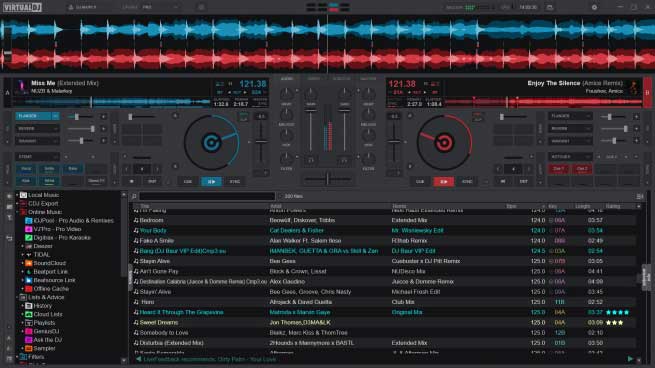
The event scheduler is the quietly useful part for a party. You can build a playlist that mixes itself for the first hour while you are still greeting people, then take manual control when the room fills up.
Serato DJ Pro and Serato DJ Lite
Serato was founded in 1998 and is the software most widely used by working club and hip-hop DJs. It ships in two versions: Serato DJ Lite, which Serato offers as a free download for beginners, and Serato DJ Pro.

Pricing has moved to a subscription-first model. Serato lists DJ Pro at $11.99 a month or $299 as a one-time purchase, with the fuller Serato DJ Suite — bundling Studio, DVS, Video, Pitch ‘n Time, Flip, Play and Club Kit — at $14.99 a month or $499 outright.
Lite is genuinely usable for a party. It gives you two decks, sync, cue points and library management, which is the whole job. The Pro upgrade buys four decks, deeper effects and hardware support you do not need at home.
Traktor Pro 4
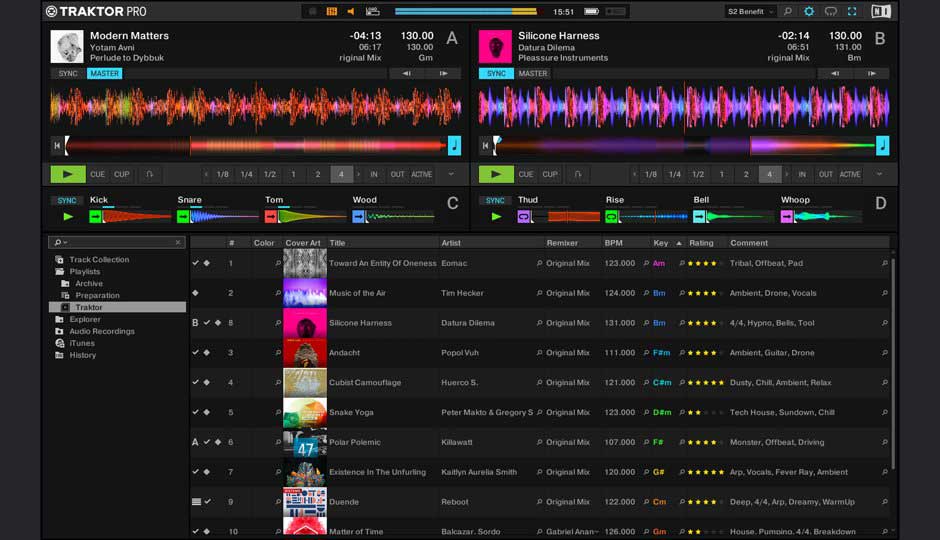
Native Instruments has replaced Traktor Pro 3 with Traktor Pro 4, and the headline addition is stem separation powered by iZotope’s RX technology, splitting tracks into drums, bass, instruments and vocals with independent volume and filter control on each.
It is a one-time purchase at $149, with no free version of Pro 4. Native Instruments offers a cut-down two-deck application called Traktor Play instead, and lets you mix unlimited two-minute Beatport previews without logging in.
The trade-off is the streaming list. Traktor connects to Beatport and Beatsource and nothing else, so if your music lives in Spotify or Apple Music, this is the wrong app for you regardless of how good the stems are.
rekordbox
rekordbox is made by AlphaTheta, the company behind the Pioneer DJ hardware found in most clubs. If you ever intend to play on a club’s CDJs, this is the library format they expect.

The plan structure is a subscription ladder. AlphaTheta lists a Free tier with basic music management and performance and one device sync, then Core at $12 a month, Creative at $18 and Professional at $36, with stems, DVS, video, DJM effects and cloud library sync distributed across the paid tiers.
For a party, the free tier does the job and the ability to run multiple streaming services at the same time is a genuine convenience if your collection is split across two of them.
Mixxx, the Free Open-Source Option
Mixxx is free and open source, with no tiers, no subscription and no watermark. It runs on Windows, macOS and Linux, and it is the only serious DJ application with proper Linux support.

It offers four decks, key and pitch control, beat looping, sync, hot cues, DVS-style vinyl control and native MIDI and HID controller support. Stem mixing support was added through a Google Summer of Code project in 2024.
What Mixxx does not have is streaming integration. It plays files you own, which for a house party is arguably the more reliable arrangement anyway.
Ableton Live and PCDJ DEX
Ableton Live is a digital audio workstation rather than DJ software, but its warping engine — elastic beat-gridding that holds tracks in time regardless of tempo — makes it viable for performance, and some electronic acts use nothing else. It is a poor first choice for a party because the learning curve is far steeper and there is no library browser designed for taking requests.
PCDJ DEX 3 runs on Windows and macOS and covers four decks, audio and video mixing, vinyl simulation and karaoke hosting. The karaoke support is the reason to pick it — no other application on this list treats karaoke as a first-class feature, and for some parties that is the whole evening.
Setting Up and Running the Night
Most party disasters are logistical, not musical. Work through this before anyone arrives.
- Install the software and let it analyze your entire library. Analysis builds the beat grids and waveforms, and it is slow. Doing it while guests wait is miserable.
- Get the music onto the laptop’s internal drive. Not a streaming service, not a network share, not a USB stick that might be knocked out.
- Turn off automatic updates, sleep, screen timeout and every notification. On Windows this means setting a power plan that never sleeps and enabling Do Not Disturb.
- Connect the audio and set levels with a track playing, not in silence. Aim for the app’s meters sitting below the red, and leave the speaker volume with room to go up.
- Build three or four playlists by energy level rather than one long list — arrival, building, peak, wind-down. You then pick from a folder of twenty rather than scrolling two thousand tracks under pressure.
- Set a fallback. A phone with a long playlist and a spare cable, so that if the laptop dies, music resumes in thirty seconds.
Keep the laptop plugged in and somewhere people cannot reach it with a drink. A laptop running audio for six hours also runs warm, so leave the vents clear — if it starts throttling you get audio dropouts, and our guide to dealing with an overheating laptop explains why the fans matter here.
Choosing Between the Options
For a one-off party with no controller, VirtualDJ’s free tier is the strongest starting point because the free license covers precisely this situation and the software is fully featured within it.
If your music sits in a streaming subscription, let that decide. Spotify or Apple Music users should look at djay, rekordbox or Serato; Beatport users can use anything; anyone who owns their files outright can use Mixxx and pay nothing forever.
Traktor Pro 4 at $149 outright is the best value only if you will keep DJing and want the strongest stem separation, since a one-time purchase overtakes a subscription within about two years.
Can I really DJ a party with just a laptop and no controller?
Yes. Every application here runs fully with no hardware attached. The main compromise is headphone cueing, because a single stereo output cannot carry the master mix and the cue signal separately. Some apps split the output into two mono channels as a workaround, and a cheap USB audio interface solves it properly.
Which DJ software is genuinely free?
Mixxx is free and open source with no restrictions. VirtualDJ is free if you are not DJing professionally and not using a controller or mixer. Serato DJ Lite and the rekordbox Free plan are both free, cut-down versions of paid products. djay is a free download with paid tiers.
Can I DJ using Spotify?
Yes, since September 2025, but only in rekordbox, Serato DJ Pro and djay — Traktor and VirtualDJ were not included. You need a Spotify Premium subscription, you must stay online throughout, there is no offline caching, and some editing features such as cue points and stems are restricted on streamed tracks.
What laptop specification do I need?
Less than you would think. Traktor Pro 4 lists a minimum of an Intel Core i5 and 4GB of RAM on macOS 13 or Windows 11. In practice a current Core i5 or Ryzen 5, 16GB of RAM and an SSD covers everything including real-time stem separation, which is the most demanding feature in any of these apps.
Is Serato better than Traktor?
They target different users. Serato dominates club and hip-hop DJing and connects to almost every streaming service; Traktor Pro 4 has strong stem separation and a one-time $149 price but only reaches Beatport and Beatsource. Serato costs $11.99 a month or $299 outright. For a home party neither is necessary.
Do I need to download my music, or can I stream it live?
Download it. Every streaming integration requires a live internet connection while you perform and none offer offline caching, so a Wi-Fi drop silences the deck mid-track. Streaming is useful for finding and auditioning music; the set itself should run from files on the laptop’s own drive.
Will the software work on Windows 10?
Increasingly not. Microsoft ended support for Windows 10 in October 2025 and the DJ vendors have moved their minimum requirements up — Traktor Pro 4 lists Windows 11, and djay requires Windows 11 or Windows 10 version 21H1 and later. Expect the remaining Windows 10 support to disappear.
Final Thoughts on DJing a Party From a Laptop
The software problem is solved — a free application and a laptop you already own will carry a party perfectly well. The things that go wrong on the night are a sleeping laptop, a dropped Wi-Fi connection and a library that was never analyzed.
Pick the app that connects to wherever your music actually lives, get the files onto the internal drive, and spend the saved money on a cheap audio interface so you can hear the next track before the room does.