Your HP charger has died, gone missing, or arrived in a drawer full of near-identical bricks, and you need to know which one your laptop actually takes. Getting it wrong ranges from mildly annoying — a machine that charges slowly or refuses to charge at all — to genuinely damaging.
Three things identify an HP adapter: the connector, the output rating, and the part number. This guide covers all three, plus what changed once HP moved much of its range to USB-C Power Delivery, and how to avoid the counterfeit adapters that flood marketplace listings.



Last update on 2026-10-21 / Affiliate links / Images from Amazon Product Advertising API
What’s Inside
What Happens if You Use the Wrong HP Charger
The outcomes are not all equal, and the internet tends to blur them together. Sorting them out makes the identification steps below easier to follow.
- Wrong output voltage: the genuinely dangerous case. Too high can damage the charging circuit and the board; too low means the machine will not run.
- Correct voltage, too little wattage: the adapter runs hot and the laptop charges slowly or not at all under load. HP states that a lower-wattage USB-C charger may charge slowly during heavy use but will not damage the laptop.
- Correct voltage, more wattage: harmless. HP confirms you can safely use a higher-watt USB-C charger, because the device draws only the power it needs.
- Wrong connector forced in: damages the plug tip, the DC jack, or both — and a loose jack afterwards is a board-level repair, not a cable swap.
- Unrecognized adapter: HP’s barrel chargers use an identification contact, so a non-conforming adapter can leave the machine running on mains without charging, often with an on-screen warning.
How to Identify an HP Laptop Charger
Part number or spare number
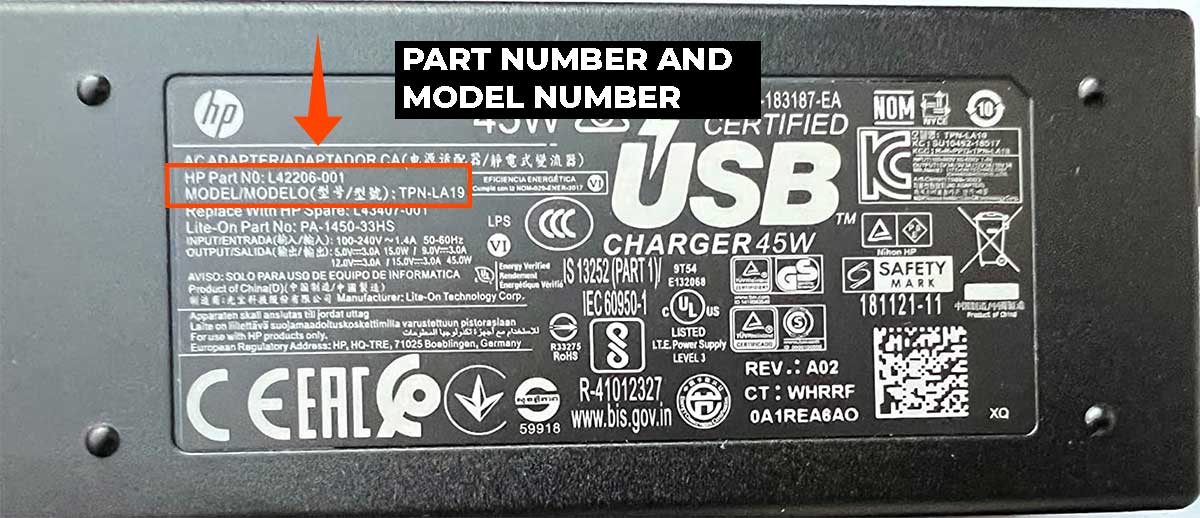
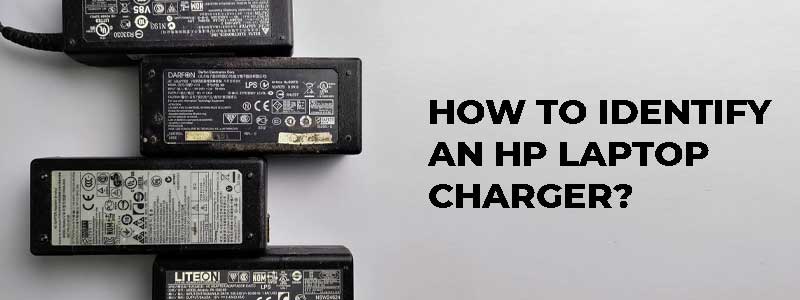
If you still have the old adapter, this is the fastest route. Every HP power adapter carries a model number and an HP spare or part number on its label, and the spare number identifies one exact adapter rather than a family of similar ones.
Search the spare number first. Listings that match it are the same adapter; listings that only match the wattage may differ in connector or in whether the identification contact is implemented correctly.
Connector type
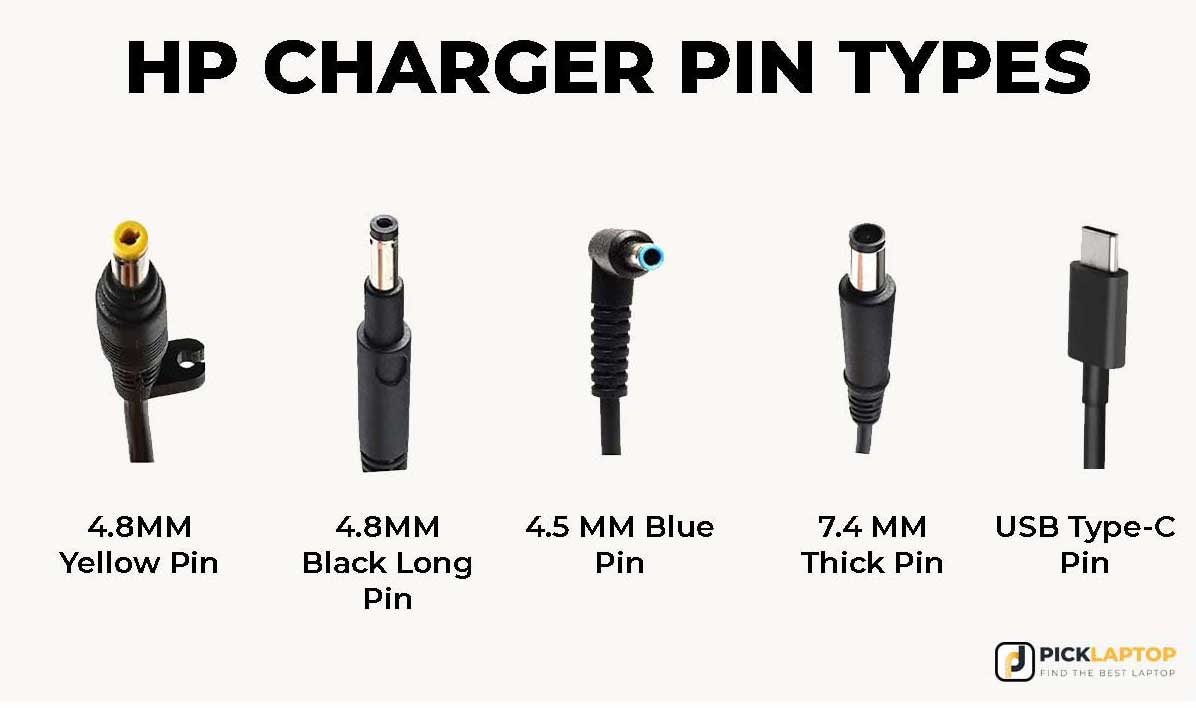
HP’s current range narrows to a small set of connectors. Its own charging guide lists the 4.5 × 3.0 mm blue-tip Smart Pin barrel, the 7.4 × 5.0 mm black-tip Smart Pin barrel used on workstations and gaming models, USB-C Power Delivery up to 240W, and proprietary connectors on some high-end gaming systems.
The “Smart Pin” name refers to the extra center contact inside the barrel that lets the laptop identify the adapter’s capability. A barrel that is dimensionally correct but lacks a working center pin can leave you with a machine that powers on but never charges.
Color is a useful shortcut on HP barrels — blue tip for the 4.5 mm, black for the 7.4 mm — but measure if you have any doubt, because the two are not interchangeable without HP’s own 4.5-to-7.4 mm dongle.
Last update on 2026-10-21 / Affiliate links / Images from Amazon Product Advertising API
Output ratings on the label
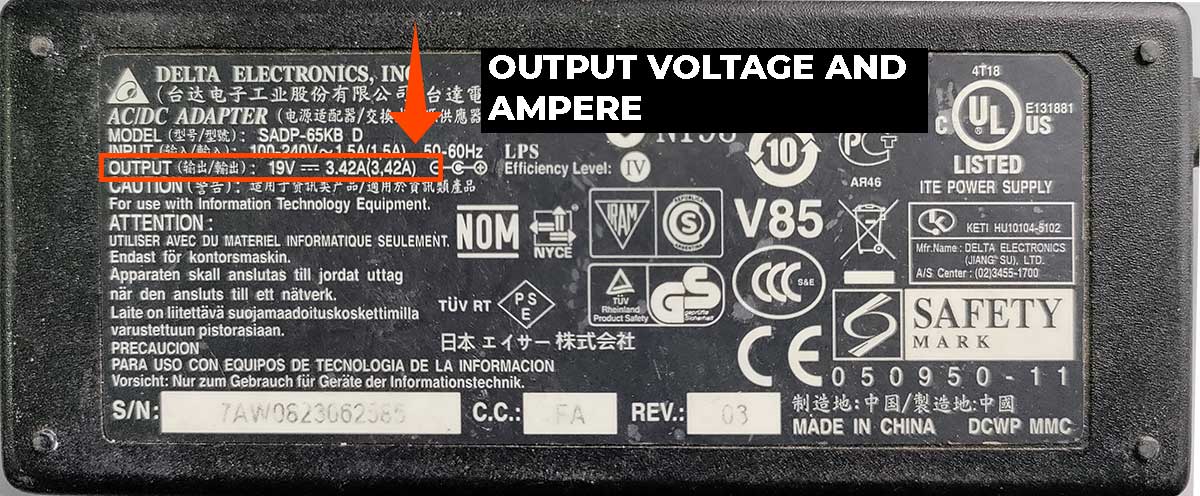
Every adapter label carries an input and an output block. The input is the mains side — typically a 100–240V range, which is what makes modern adapters usable worldwide with only a plug adapter.
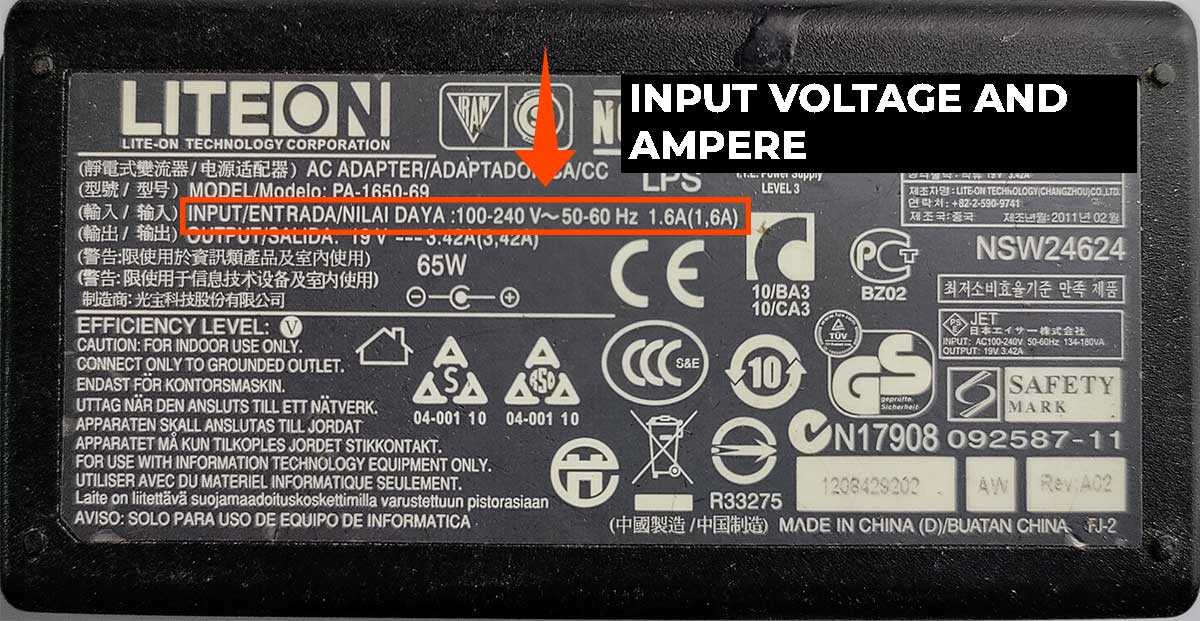
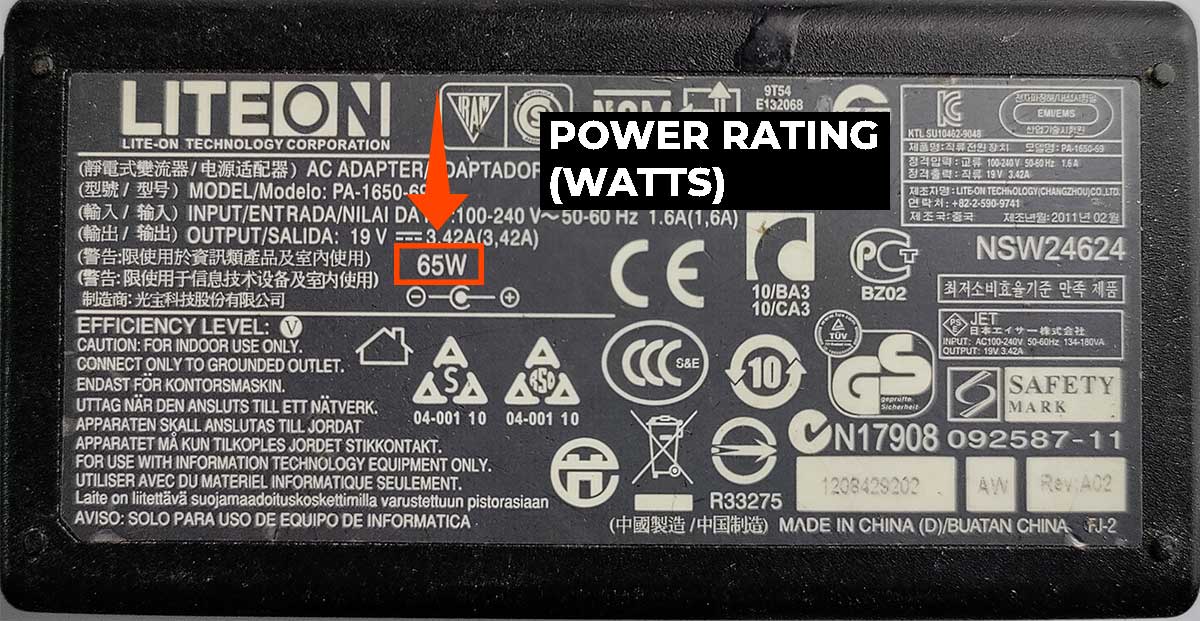
The output block is the one that has to match. It gives a DC voltage and a current, for example 19.5V and 3.33A, which multiply out to the wattage printed alongside — 65W in that case.
Match the voltage exactly. HP’s guidance for barrel adapters is that voltage must match exactly while amperage can be equal or higher, across common ratings of 45W, 65W, 90W, 120W, 150W and 200W or more.
Identifying by laptop model number
With no adapter to read, work from the machine instead. The model and product number are on the label on the base of the laptop, and HP’s support site returns the correct adapter spare number for that product.
You can also read it from Windows. On Windows 11, Microsoft’s route is right-click Start, then Settings, System, About, where the device name and model appear at the top.
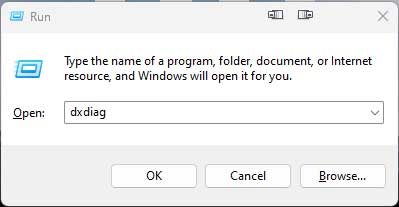
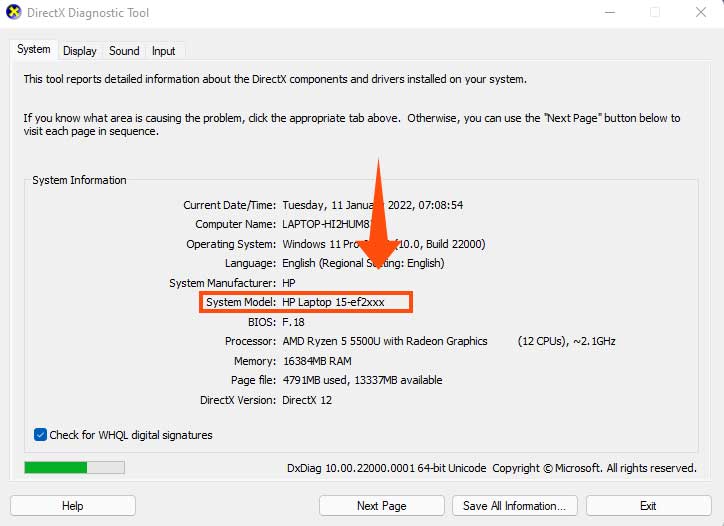
The older shortcut still works too: press Windows + R, type dxdiag, and read the System Model line in the DirectX Diagnostic Tool. Either way, take the number to HP’s parts lookup rather than guessing from a marketplace search.
How USB-C Power Delivery Changed HP Charging
Much of HP’s current lineup charges over USB-C, and that removes most of the matching problem. Instead of a fixed voltage on a keyed barrel, the laptop and the charger negotiate what to supply.
HP describes the effect plainly: a 65W USB-C charger automatically delivers 15W, 27W, 60W or 65W depending on the device connected. One charger can cover a phone, a tablet and a laptop.
USB-PD now reaches 240W. The USB-IF specification adds 28V, 36V and 48V fixed voltages for 140W, 180W and 240W over a full-featured USB-C cable. That is why HP can list USB-C charging on machines that once needed a large barrel brick — but the cable has to be rated for it, not just any USB-C lead you own.
Two caveats remain. Not every USB-C port on an HP laptop accepts charging — check for the charging or Thunderbolt marking beside the port — and above 100W you need an EPR-rated cable, because a standard USB-C cable will hold the link down to the lower power range.
Avoiding Counterfeit and Underpowered Adapters
Fake chargers fail safety tests at a startling rate. Electrical Safety First tested 50 counterfeit and lookalike chargers bought in the UK and reported that 49 of the 50 failed basic safety checks, with 68% carrying a severe risk of electric shock. The test covered phone chargers, but the failure is in how cheap switch-mode supplies are built, and laptop adapters are built the same way at higher power.
HP’s own advice is to avoid unbranded or suspiciously cheap chargers, warning that they may lack basic protections and can overheat, damage batteries, start fires or electrocute users, and it flags missing safety marks and misspelled branding as red flags.
Practical checks before you buy: a printed spare or part number rather than only a wattage, legible safety marks and a named manufacturer on the label, a price that is not a fraction of everyone else’s, and a seller who is HP or an authorized reseller. On arrival, a genuine adapter feels dense for its size — a suspiciously light brick usually means the internal isolation and filtering were left out.
A charger that runs uncomfortably hot, buzzes, or smells of hot plastic should come out of the socket and stay out. The same goes for one that makes the DC jack hot, which points at a poor contact rather than a bad adapter.
HP Charger Compatibility Questions Answered
Do all HP laptops use the same charger?
No. HP ships 4.5 mm and 7.4 mm barrel connectors, USB-C Power Delivery, and proprietary connectors on some gaming models, across wattages from 45W to more than 200W. Voltage, connector and wattage all have to line up.
Can I use a 65W charger instead of a 45W HP charger?
Yes, provided the voltage and connector match. The laptop draws the current it needs and the extra headroom is simply unused. HP confirms a higher-wattage USB-C charger is safe for the same reason.
What happens if I use a 90W charger instead of a 65W one?
Nothing harmful at the correct voltage. It will not overcharge the battery. It may charge a little faster if the laptop is able to draw more than 65W, and otherwise behaves identically to the smaller adapter.
Do more watts always mean faster charging?
Only up to what the laptop is designed to accept. A machine rated for 65W charging will not pull 100W from a bigger adapter. Beyond the laptop’s own limit, extra wattage changes nothing.
Will any USB-C charger work with an HP laptop?
Only if the port supports charging and the charger supplies enough power. A low-wattage phone charger may connect and still lose ground against the machine’s own consumption under load. For over 100W you also need an EPR-rated USB-C cable.
Why does my HP laptop say the adapter is not supported?
That message means the machine could not identify the adapter or read enough capability from it — commonly a broken center Smart Pin contact, a damaged cable, or a third-party adapter that does not implement identification correctly. The laptop will often run on mains without charging in this state.
Can I use my HP charger abroad?
Almost always. Check the input line on the label: a 100–240V, 50/60Hz rating means the adapter handles both regional standards, and you need only a physical plug adapter rather than a voltage converter.
Is a third-party HP charger always a bad idea?
Not always, but the risk sits entirely in the manufacturing. A charger from an established brand with proper safety certification and a matching output is a reasonable substitute; an unbranded marketplace adapter with no part number and no safety marks is the category that fails safety testing.
Final Thoughts on Choosing the Right HP Adapter
Match the output voltage exactly and the connector exactly; treat wattage as a floor you can exceed but not fall below. On a USB-C model most of that decision disappears into the negotiation, leaving the cable rating as the thing people overlook.
Buy from HP or an authorized seller, insist on a part number and visible safety marks, and plug in gently — a bent barrel tip is how a cheap adapter turns into an expensive jack repair.