A laptop that only charges when you hold the plug at an angle, or has stopped charging entirely, usually has a fault in one of three places: the adapter, the cable, or the DC-in jack on the machine itself. Working out which one before you open anything saves both money and risk.
Most people searching for this want a fix that avoids soldering. That is possible on some designs and genuinely not on others, and this guide is honest about which is which — along with the safety steps that matter and the point at which the sensible move is to hand the board to someone with the right bench.
Read this before you open the machine. Shut the laptop down, unplug the charger, and disconnect the internal battery connector from the board — powering off alone leaves the board live. Microsoft’s repair safety guidance tells technicians to disconnect from mains before opening a device, wear an anti-static wrist strap on a grounded surface, avoid conductive tools near the battery, and stop entirely on finding burned or melted components or a swollen battery. A lithium cell must never be punctured, bent or crushed.
What’s Inside
- 1 – How a Laptop DC Jack Connects to the Charger
- 2 – Check the Adapter Before Blaming the Jack
- 3 – Identify Which DC Jack Fault You Have
- 4 – Fixing Physical Damage to the Jack
- 5 – Repairing Wires, Pins and Motherboard Tracks
- 6 – When to Stop and Use a Repair Shop
- 7 – Laptop Power Jack Repair Questions Answered
- 8 – Final Thoughts on Repairing a Laptop DC Jack
How a Laptop DC Jack Connects to the Charger
Most barrel-style laptop chargers carry two connections: positive and ground. Several manufacturers add a third center contact used for adapter identification, so the machine can tell what it has been plugged into — HP calls its blue-tip 4.5 × 3.0 mm and black-tip 7.4 × 5.0 mm connectors Smart Pin designs, and Dell uses the same idea.
That third pin matters for diagnosis. If the sense line is broken but power still gets through, a machine will often run on the adapter while refusing to charge the battery, or display a warning that the adapter is not recognized.
Newer laptops increasingly drop the barrel jack for USB-C Power Delivery, where negotiation happens over the data contacts rather than a dedicated sense pin. USB-PD now runs to 240W using 28V, 36V and 48V fixed voltages, which is why full-size machines can charge from a USB-C port at all.
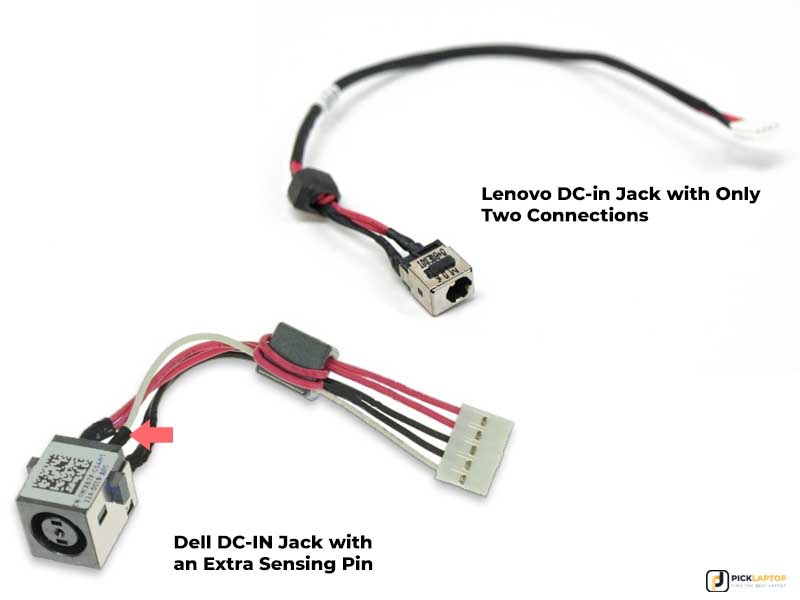
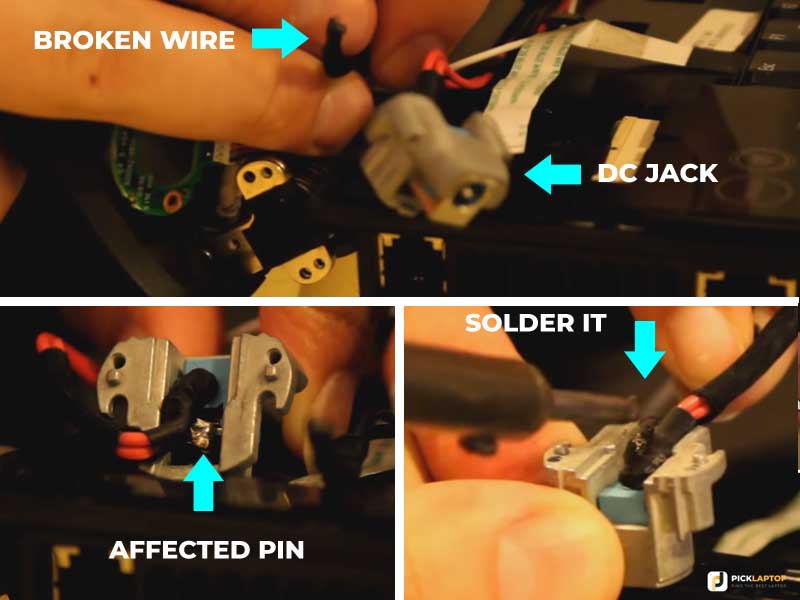
The jacks pictured above have wires crimped into a connector that plugs into the motherboard. That layout is the one where a repair without touching the board is realistic, because the failure is usually in the pigtail rather than the board.
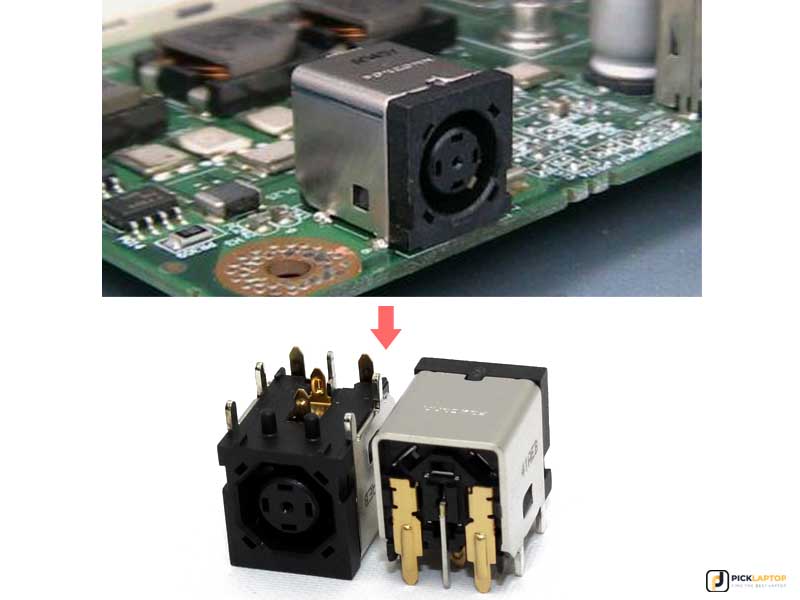
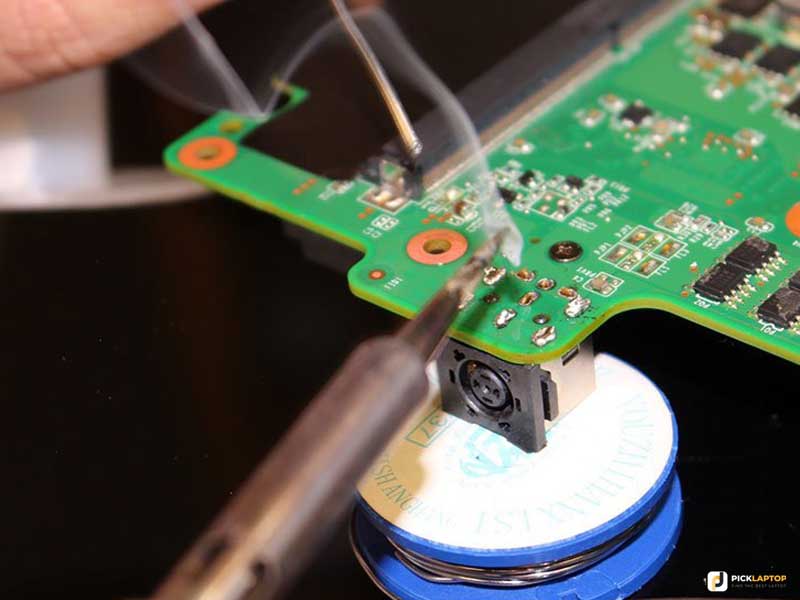
The jack below is soldered directly into the motherboard. On that design there is no no-solder fix — anything glued, wedged or bodged into place will arc and heat under load, and that failure mode takes the board with it.
Check the Adapter Before Blaming the Jack
Visible damage to the jack settles the question on its own. Otherwise, start with the adapter, because it is the part you can test without opening anything.
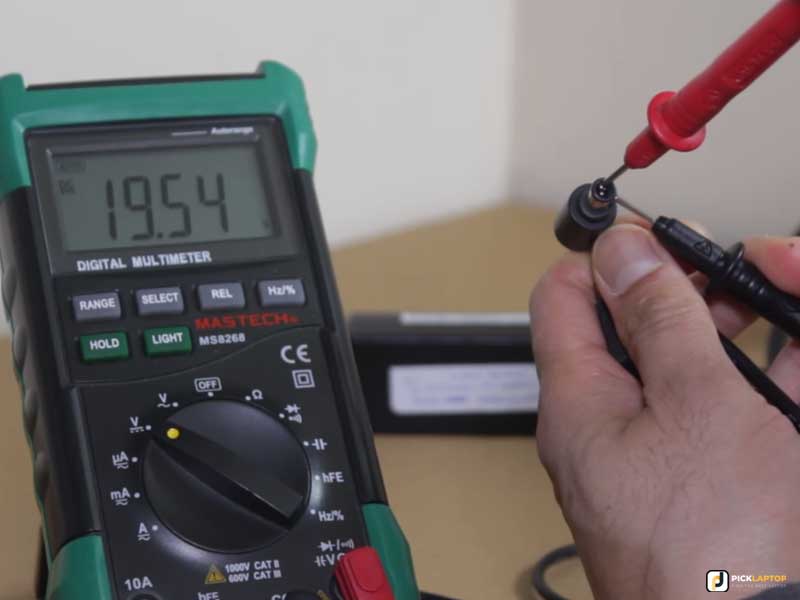
Plug the adapter into the wall, set a multimeter to DC volts, and measure between the barrel’s outer sleeve and its center contact. The reading should sit close to the output voltage printed on the adapter label.
This is not conclusive. An adapter can read correctly with no load and collapse as soon as the laptop draws current, so a good open-circuit reading only makes the laptop the more likely suspect. If you have access to a known-good adapter of the correct rating, swapping it in is a stronger test than any meter reading. The same care applies when you put a meter on the battery pack.
Never test the mains side of an adapter. Measure only at the low-voltage DC output plug. The primary side of a switch-mode supply holds a lethal charge on its bulk capacitor after unplugging, and a sealed adapter brick is not a user-serviceable item — if the adapter is the fault, replace it.
Identify Which DC Jack Fault You Have
“Power jack repair” covers several distinct faults with different fixes and very different difficulty. Match your symptom to this list before going further.
- The center pin inside the jack is bent or broken.
- The jack body itself is cracked or crushed.
- The jack sparks on insertion, or the plug and jack get hot in use.
- The jack has been pushed back into the chassis and no longer lines up with the port opening.
- A motherboard track between the jack and the charging circuit is burned or lifted.
- The jack wobbles on the board when you insert the plug, which points at cracked solder joints.
Sparking or heat at the connector is the one to take seriously. That is arcing across a resistive joint, it gets worse every time you plug in, and it can char the board — stop using the machine on mains power until it is fixed.
Fixing Physical Damage to the Jack
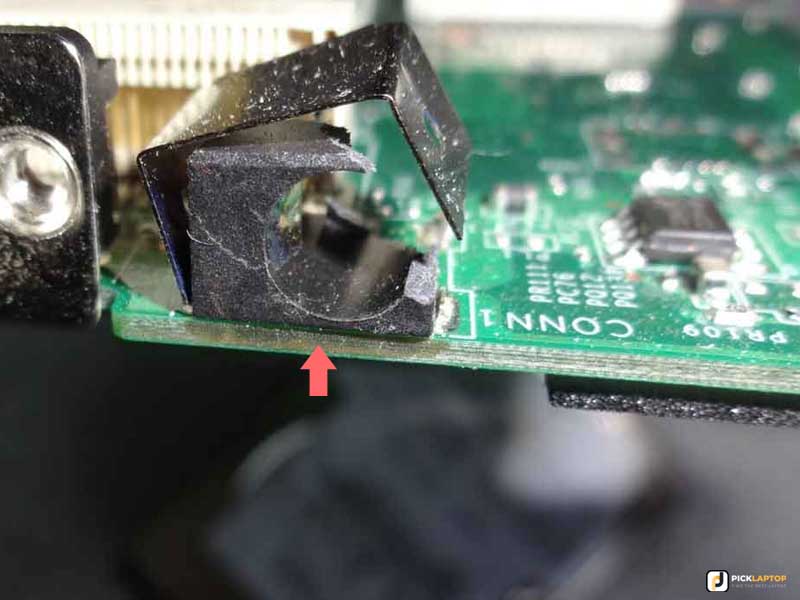
A broken center pin or a cracked jack body is not repairable — it gets replaced. Gluing a loose jack back together leaves an intermittent contact, and an intermittent contact under a 65W or 90W load means arcing, heat, and damage that spreads to the plug and the board.
Source the part by searching your exact model followed by “dc jack” — for example, “Lenovo G560 dc jack”. Match the barrel dimensions and the pin count, not just the picture.
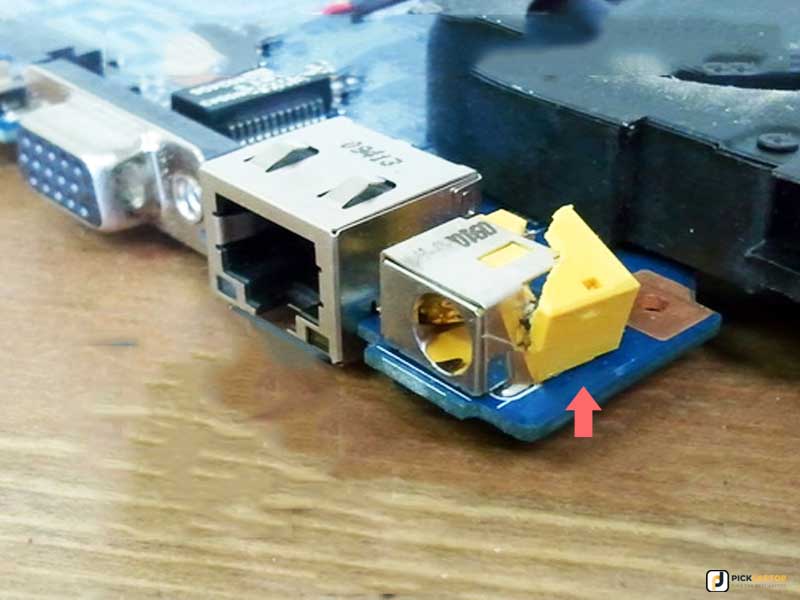
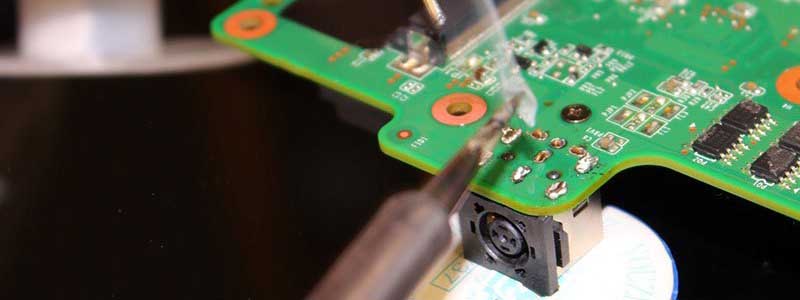
With the battery disconnected, unplug the jack’s connector from the board and release its retaining screw or clip to lift it out. If the jack is soldered into the board instead, removal is the hardest part of the whole job — heat is applied to a multi-layer board with large ground planes, and pulling a pin before the solder is fully molten tears the plated through-hole out with it.
Repairing Wires, Pins and Motherboard Tracks
If the jack is physically sound, the fault is in the path between it and the charging circuit. How you fix that depends entirely on which of the two mounting styles your laptop uses.
Scenario 1: the jack has its own cable and connector
Unplug the jack’s connector from the motherboard, then plug the charger into the jack and measure across the connector’s pins. No voltage there, with a working adapter, confirms a break in the pigtail.
Find the broken conductor — usually where the cable flexes at the jack body — rejoin it, and solder the joint properly. Heat-shrink tubing over each conductor, then over the bundle, restores the strain relief the original molding provided. Re-measure before reassembling.
Where the whole pigtail assembly is sold as a cheap replacement part, fitting a new one is the better repair. A splice in a cable that already failed from flexing is a splice in the place it flexes most.
Scenario 2: the jack is soldered to the motherboard
Everything below is board-level work. A pencil iron on a large ground plane will not reach reflow temperature at the joint, so you keep it there longer, and that is how pads lift and tracks burn.
The realistic minimum kit is a temperature-controlled iron with a decent-mass chisel tip, no-clean flux, solder wick or a desoldering gun, and ideally a hot-air station or preheater to bring the board up before you work on it. Without that, this is a job to pay for rather than practice on your own laptop.
Soldering fume is a real hazard, not a nuisance smell. The UK Health and Safety Executive warns that rosin-based solder flux fume can cause occupational asthma and that extraction should be used at the point of soldering. Work with fume extraction or good cross-ventilation, keep your face out of the plume, and if you use leaded solder, keep food away from the bench and wash your hands afterwards.
A wobbling jack: cracked solder joints
This is the most common soldered-jack fault and the most repairable. Years of plug insertions fatigue the joints until they crack, contact becomes intermittent, and the resulting resistance generates heat.
Flux every pin, then reflow each joint with fresh solder so the old cracked alloy is replaced rather than simply remelted. Add solder — do not just touch the iron to a dry joint and hope. The jack should end up rigid against the board with no movement when you push a plug in.
Burned tracks or a damaged pad
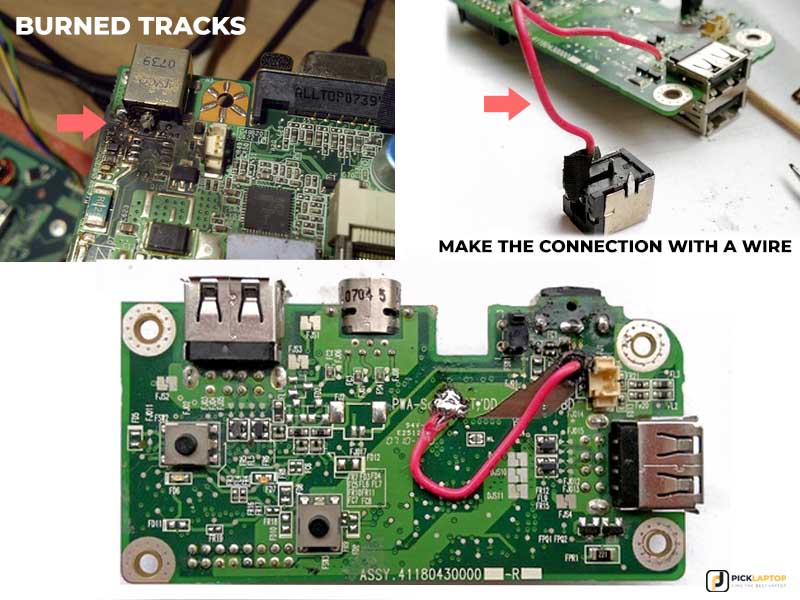
Burned copper is visible damage and advanced repair. You have to establish which conductor failed — positive, ground, or the sense line — and where that track was going, then bridge the break with a wire from the jack pin to the next intact point on that net.
Use wire rated comfortably above the charging current, and check continuity against the board’s other side before you power anything up. A wire soldered to the wrong net can put adapter voltage somewhere that was never meant to see it, and that is the failure that turns a jack repair into a dead motherboard.
Once it tests good, secure the joint with hot glue or epoxy so the plug’s leverage is taken by the potting rather than the solder. Keep adhesive out of the connector bore.
When to Stop and Use a Repair Shop
Stop and hand it over if the jack is soldered to the board and you do not own a temperature-controlled iron, if there is any charring or a burned smell, if the battery is swollen, or if the machine holds data you cannot afford to lose. A botched board repair is frequently unrecoverable, and there is no undo.
The economics are less punishing than people assume. Parts-People, which specializes in Dell service, lists DC power jack repair at a flat $149 labor rate plus parts and shipping, with a one-year warranty. Local independents are often cheaper; get a quote before assuming the repair is not worth it.
Weigh that against the machine’s value. On a laptop worth a few hundred dollars, a board-level repair with a warranty is usually the better outcome than a first attempt at through-hole desoldering.
Laptop Power Jack Repair Questions Answered
How do I know if my laptop charger port is broken?
Common signs are a plug that no longer clicks in firmly, a broken or bent center pin, charging that only works at a certain angle, or visible movement of the jack when you insert the plug. Heat or sparking at the connector is a definite fault. Confirming it fully means opening the machine, so rule out the adapter and cable first.
Can a laptop power jack be fixed without soldering?
Only where the jack is a separate module with a cable and connector — then you can swap the whole assembly. When the jack is soldered directly into the motherboard, which is common, there is no no-solder fix that is safe to leave in service.
How do you solder a DC power jack?
Seat the jack fully in its holes, flux the pins, then heat each pin and pad together and feed solder into the joint until it flows and fills the hole. A larger chisel tip and board preheat help far more than a hotter iron. On a cabled jack there is nothing to solder — the connector plugs in and the jack is screwed back into place.
Why is my laptop plugged in and not charging?
A worn-out battery is one cause, but not the only one. A broken sense pin or sense line lets the machine run on the adapter while refusing to charge, an underrated adapter can produce the same behavior, and battery-health firmware on many business laptops deliberately holds the charge below full. Check the vendor’s battery report and power settings before replacing hardware.
Can I leave my laptop plugged in overnight?
Yes. The charging circuit stops charging the cell once it is full, so there is no overcharge risk from leaving it connected. Sitting permanently at 100% is not ideal for long-term battery health, which is why vendors ship charge-limit options.
Can I use a different brand charger with my laptop?
Only if the output voltage matches exactly, the polarity and connector match, and the wattage is equal to or higher than the original. A higher-wattage adapter at the correct voltage does not force extra current into the laptop — the machine draws what it needs. A lower-wattage one will run hot, charge slowly or shut down under load. The wrong voltage is what causes damage.
Can you charge a USB-C laptop with a phone charger?
If the laptop charges over USB-C, a USB-PD phone charger will usually connect, but the two negotiate down to whatever the smaller charger can supply. A 20W phone charger may only slow the battery drain on a machine that expects 65W or more, and some laptops refuse to charge below a minimum wattage.
Is it bad to use a laptop while it is charging?
No. The system runs from the adapter and charges whatever current is left over, which is exactly how the hardware is designed to work.
How do I find out which charger my laptop needs?
The output voltage, current and wattage are printed on the original adapter’s label, and the requirement is listed in your model’s service manual or spec sheet. If you no longer have the adapter, search the model number from the sticker on the base of the machine and match voltage, connector size and wattage.
Final Thoughts on Repairing a Laptop DC Jack
Diagnosis is most of this job: rule out the adapter, then work out whether your jack is a cabled module or soldered into the board, because that single fact decides whether this is a twenty-minute swap or board-level work.
Disconnect the battery, keep the machine off mains while a connector is arcing, and treat a soldered jack you are not equipped for as a shop job rather than a learning exercise on hardware you need.
Amazing! this is what I was looking for. Luckily, my laptop jack doesn’t require soldering to replace it, this guide made my day. Thank you:)
Thank you, Alfred, for your valuable comment!
Thank you very much, I have successfully replaced my dc jack on hp pavilion laptop, and it’s working again. Actually, there was only one wire broken from the dc socket. I have soldered both wires back for better strength.
We are thrilled to know that it helped you. Thanks, Rocky!
I have li-ion battery pack with capacity of 17v/4.8ah
Shall I used my old Dell laptop 17v charger to charging this battery pack?
Hi Navanath — matching voltage alone isn’t enough here; you’d also need the charger’s current (amperage) and connector polarity to match your battery pack’s spec, or you risk damaging it. If in doubt, it’s safer to use a charger rated specifically for that battery pack rather than repurposing a laptop charger.
I have a trekstor w1 surfbook,the jackport is broken ,pin gone,I have contacted the company,who will only sell mother board,as I have experience of soldering I want to replace jack but can’t find a port that’s compatable,despite a lot of searching on the internet,any help would be appreciated.